Mars
Mars is the fourth planet from the Sun and the seventh largest in the Solar System. A cold, dusty desert world with a thin atmosphere (mostly CO₂), the planet features extinct volcanoes, deep canyons, polar ice caps, and seasons. Mars has two small moons (Phobos and Deimos), a day just over 24 hours long, and a year lasting about 687 Earth days. It is a prime focus of robotic exploration and studies about past water and habitability.
Source: science.nasa.gov
APODs including "Mars"
Europa: Oceans of Life?
06/08/1996
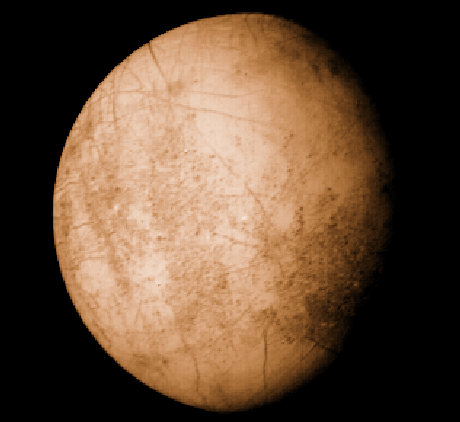
Is there life beneath Europa's frozen surface? Some believe the oceans found there of carbon-enriched water are the best chance for life, outside the Earth, in our Solar System. Europa, the fourth largest moon of Jupiter, was recently discovered to have a thin oxygen atmosphere by scientists using the Hubble Space Telescope. Although Earth's atmospheric abundance of oxygen is indicative of life, astronomers speculate that Europa's oxygen arises purely from physical processes. But what an interesting coincidence! The above picture was taken by a Voyager spacecraft in 1979, but the spacecraft Galileo is currently circling Jupiter and has been photographing Europa. The first of these pictures will be released two days from today. Will they show the unexpected? Late News: NASA to Release New Europa and Jupiter Pictures Thursday More Late News: New Evidence Suggests Microscopic Life Existed on Mars