Mars
Mars is the fourth planet from the Sun and the seventh largest in the Solar System. A cold, dusty desert world with a thin atmosphere (mostly CO₂), the planet features extinct volcanoes, deep canyons, polar ice caps, and seasons. Mars has two small moons (Phobos and Deimos), a day just over 24 hours long, and a year lasting about 687 Earth days. It is a prime focus of robotic exploration and studies about past water and habitability.
Source: science.nasa.gov
APODs including "Mars"
Earth Nears Asteroid Toutatis
20/01/1997
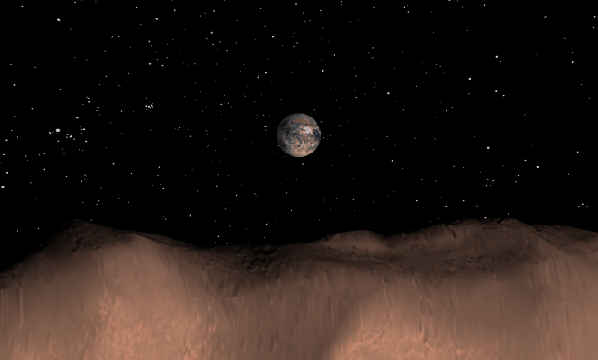
On November 29, 1996 the Earth came within 3.3 million miles of the asteroid Toutatis. Above is a computer simulated picture of this spectacle from the surface of Toutatis (a 2.5 degree field of view looking toward Earth). In Earth's sky, Toutatis appeared only as a faint object moving against a background of stars. Also known as Earth-crossing asteroid 4179, Toutatis is in an eccentric 4 year orbit which moves it from the asteroid belt between Mars and Jupiter to just inside Earth's orbit. When the Earth passed near it in 1992 Toutatis was imaged by radar and seen to be two irregularly shaped lumps, perhaps joined by a narrow neck. This bizarre object is up to 1.5 miles wide, 2.9 miles long, and is tumbling through space. In the year 2004, on September 29, the Earth will pass very near Toutatis, closing to within a million miles (4 times the Earth-Moon distance) - the closest approach predicted for any asteroid or comet between now and 2060. Studies of Toutatis and other Earth-crossing asteroids help reveal connections between the Solar System's meteorites,main-belt asteroids and comets. These wayward asteroids also offer tantalizing targets for robotic exploration and, over time, represent potential collision hazards for planet Earth!