Mars
Mars is the fourth planet from the Sun and the seventh largest in the Solar System. A cold, dusty desert world with a thin atmosphere (mostly CO₂), the planet features extinct volcanoes, deep canyons, polar ice caps, and seasons. Mars has two small moons (Phobos and Deimos), a day just over 24 hours long, and a year lasting about 687 Earth days. It is a prime focus of robotic exploration and studies about past water and habitability.
Source: science.nasa.gov
APODs including "Mars"
Strange Rocks on Mars
29/07/1997
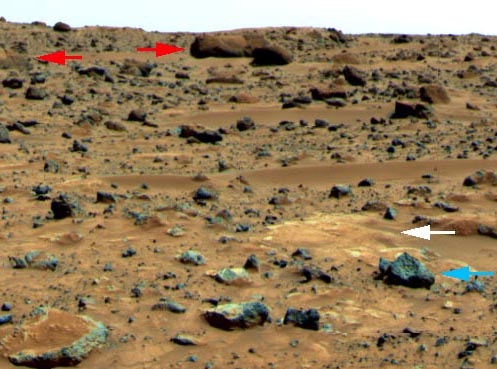
The rocks on Mars tell us stories about their past. To decipher these stories, a scientist must become a detective, searching for clues and fitting them with theories. The above photograph of the rocky Martian surface to the northeast of Pathfinder's landing site provides many such clues. For example, at least three types of rocks are evident, marked with red, white and blue arrows. The red arrows point to smooth rocks, which Pathfinder scientists hypothesize have been eroded by tumbling through ancient channels of water which evaporated long ago. The blue arrows indicate a different type of rock, ragged ones with sharp edges, hypothesized to have been ejected when nearby craters formed or volcanoes erupted. The white areas are more mysterious, and might be some sort of composite material. Sojourner was recently diverted to study these white areas to gather more clues so continued detective work can yield better insight into the Martian past.