Mars
Mars is the fourth planet from the Sun and the seventh largest in the Solar System. A cold, dusty desert world with a thin atmosphere (mostly CO₂), the planet features extinct volcanoes, deep canyons, polar ice caps, and seasons. Mars has two small moons (Phobos and Deimos), a day just over 24 hours long, and a year lasting about 687 Earth days. It is a prime focus of robotic exploration and studies about past water and habitability.
Source: science.nasa.gov
APODs including "Mars"
A Map of Asteroid Vesta
08/09/1997
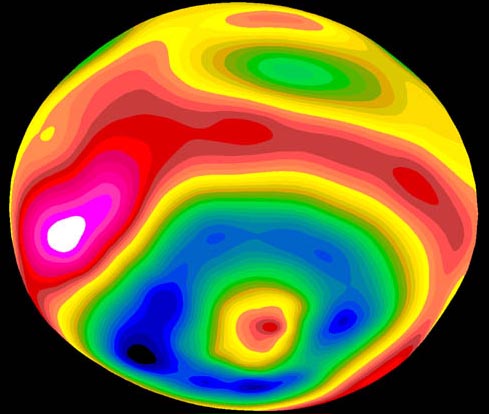
Vesta is a huge rock 500 kilometers across that orbits out past Mars. Last week, the above map of Vesta created using the Hubble Space Telescope was released showing a rugged surface highlighted by a single crater spanning nearly the entire length of the asteroid. The large crater dominates the lower part of the false-color conglomerate image: blue indicates low terrain, while red indicates raised terrain. Evidence indicates that Vesta underwent a tremendous splintering collision about a billion years ago. In October 1960, a small chunk of this rock believed to have originated on Vesta fell to Earth and was recovered in Australia.