Mars
Mars is the fourth planet from the Sun and the seventh largest in the Solar System. A cold, dusty desert world with a thin atmosphere (mostly CO₂), the planet features extinct volcanoes, deep canyons, polar ice caps, and seasons. Mars has two small moons (Phobos and Deimos), a day just over 24 hours long, and a year lasting about 687 Earth days. It is a prime focus of robotic exploration and studies about past water and habitability.
Source: science.nasa.gov
APODs including "Mars"
Olympus Mons on Mars: The Largest Volcano
15/09/1997
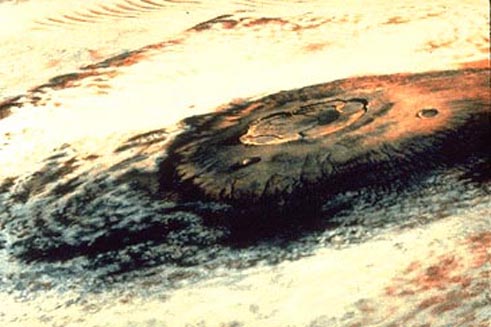
The largest volcano in the Solar System is on Mars. Olympus Mons rises 24 kilometers high and measures 550 km across. By comparison, Earth's largest volcano, Mauna Loa in Hawaii, rises 9 km high and measures 120 km across. Such large volcanoes can exist on Mars because of the low gravity and lack of surface tectonic motion. Olympus Mons is a shield volcano, built by fluid lava. Over the next three years, Mars Global Surveyor, which arrived at Mars last week, will photograph the planet at such high resolution that objects only 100 meters across will be visible. The above image was taken by Mariner 9, which orbited and photographed Mars during 1971 and 1972.