Mars
Mars is the fourth planet from the Sun and the seventh largest in the Solar System. A cold, dusty desert world with a thin atmosphere (mostly CO₂), the planet features extinct volcanoes, deep canyons, polar ice caps, and seasons. Mars has two small moons (Phobos and Deimos), a day just over 24 hours long, and a year lasting about 687 Earth days. It is a prime focus of robotic exploration and studies about past water and habitability.
Source: science.nasa.gov
APODs including "Mars"
A Martian Autumn Begins
23/09/1997
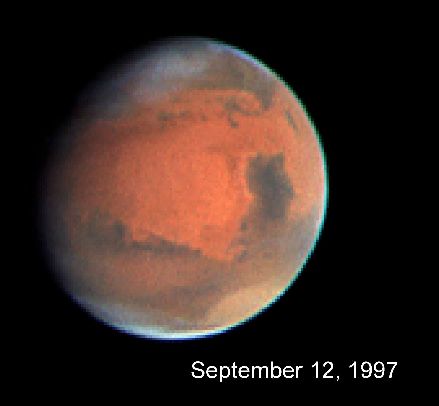
Today is the first day of Autumn in the Northern Hemisphere of Planet Earth. The Autumnal Equinox occured yesterday at 7:56 pm EDT as the Sun crossed the celestial equator from North to South. Mars has seasons too and for the same reason that Earth does -- like Earth, Mars' axis of rotation is tilted with respect to the plane of its orbit around the sun. Eleven days ago Autumn also came to Mars' Northern Hemisphere and the Hubble Space Telescope recorded this image of the red planet to look for seasonal changes in the Martian weather. Clouds appear to cover the north polar regions while a dust storm rages in the south. The subject of weather on Mars is important to the just arrived Mars Global Surveyor spacecraft as it uses the innovative technique of aerobraking to establish a suitable mapping orbit around Mars.