Mars
Mars is the fourth planet from the Sun and the seventh largest in the Solar System. A cold, dusty desert world with a thin atmosphere (mostly CO₂), the planet features extinct volcanoes, deep canyons, polar ice caps, and seasons. Mars has two small moons (Phobos and Deimos), a day just over 24 hours long, and a year lasting about 687 Earth days. It is a prime focus of robotic exploration and studies about past water and habitability.
Source: science.nasa.gov
APODs including "Mars"
Jupiter's Inner Moons
27/11/1997
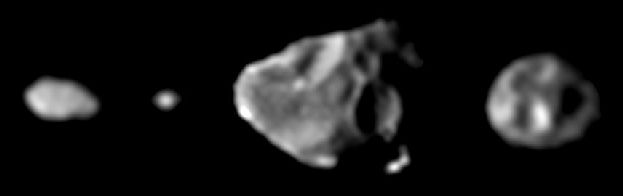
The potato-shaped inner moons of Jupiter are lined-up in this mosaic "family portrait" of these tiny Jovian satellites. The individual images were recorded over the last year by NASA's Galileo spacecraft and are scaled to the moons' relative sizes. Left to right in increasing order of distance from Jupiter are Metis (longest dimension 37 miles), Adrastea (12 miles), Amalthea (154 miles), and Thebe (72 miles). All these moons orbit in the zone between Io and Jupiter's rings, are bombarded by high-energy ions within the Jovian magnetosphere, and are probably locked in synchronous rotation by Jupiter's strong gravity. Why are they shaped like potatoes? Like the asteroids and the diminutive moons of Mars, their own gravity is not strong enough to mold them into spheres.