Mars
Mars is the fourth planet from the Sun and the seventh largest in the Solar System. A cold, dusty desert world with a thin atmosphere (mostly CO₂), the planet features extinct volcanoes, deep canyons, polar ice caps, and seasons. Mars has two small moons (Phobos and Deimos), a day just over 24 hours long, and a year lasting about 687 Earth days. It is a prime focus of robotic exploration and studies about past water and habitability.
Source: science.nasa.gov
APODs including "Mars"
Mars Volcano Apollinaris Patera
13/05/1999
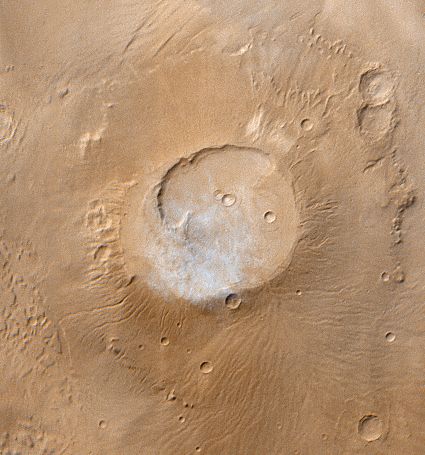
Dwarfed by Olympus Mons and the other immense shield volcanos on Mars, Apollinaris Patera rises only 3 miles or so into the thin martian atmosphere, but bright water-ice clouds can be still be seen hovering around its summit. Mars' volcanic structures known as "paterae" are not only smaller than its shield volcanos but older as well, with ages estimated to be around 3 billion years. Like Apollinaris Patera, narrow furrows typically extend from their central craters or calderas. It is thought that the paterae represent broad piles of easily eroded volcanic ash. This wide angle view of Apollinaris Patera was recorded last month by the Mars Global Surveyor spacecraft. The large central crater is about 50 miles across.