Mars
Mars is the fourth planet from the Sun and the seventh largest in the Solar System. A cold, dusty desert world with a thin atmosphere (mostly CO₂), the planet features extinct volcanoes, deep canyons, polar ice caps, and seasons. Mars has two small moons (Phobos and Deimos), a day just over 24 hours long, and a year lasting about 687 Earth days. It is a prime focus of robotic exploration and studies about past water and habitability.
Source: science.nasa.gov
APODs including "Mars"
Topographical Mars
28/05/1999
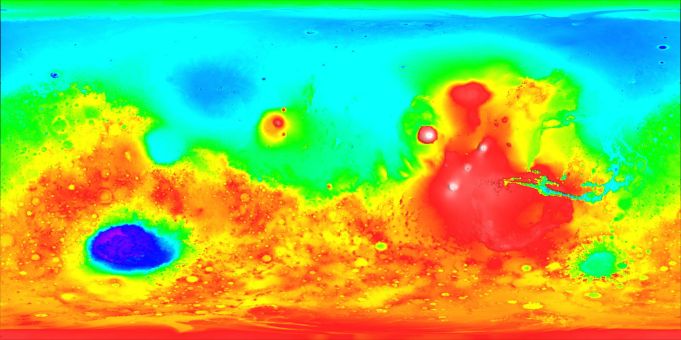
Contrasting colors trace changing elevations in this new high-resolution topographic map of Mars. Just released, the data were gathered in 1998 and 1999 by the Mars Orbiter Laser Altimeter (MOLA) onboard the Mars Global Surveyor spacecraft. The martian topography is seen to range over 19 miles between the highest volcanic peaks (white) and the lowest regions (purple). Along with the striking difference between the Red Planet's low northern hemisphere (top) and high southern regions, one of the most noticeable features on the map is the large blue-purple southern depression corresponding to the Hellas basin. Likely the result of an asteroid impact, Mars' deepest basin is about 1300 miles across making it one of the largest impact features in the Solar System. Explorations of MOLA's rich topographic database are expected to produce insights into water flows and the geologic history of Mars.