Mars
Mars is the fourth planet from the Sun and the seventh largest in the Solar System. A cold, dusty desert world with a thin atmosphere (mostly CO₂), the planet features extinct volcanoes, deep canyons, polar ice caps, and seasons. Mars has two small moons (Phobos and Deimos), a day just over 24 hours long, and a year lasting about 687 Earth days. It is a prime focus of robotic exploration and studies about past water and habitability.
Source: science.nasa.gov
APODs including "Mars"
Thermal Mars
02/06/1999
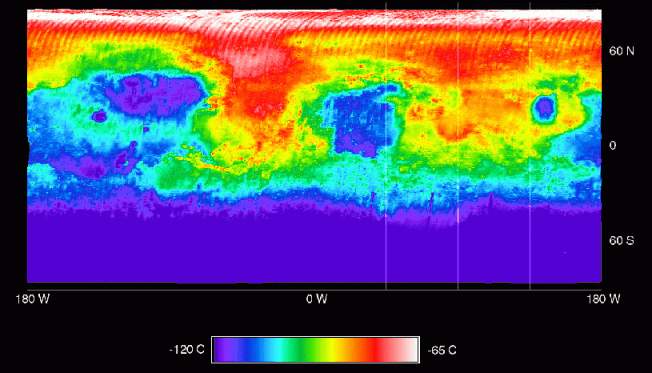
It's 2 AM on Mars and surface temperatures range from -65C to -120C, as measured by the Thermal Emission Spectrometer (TES) onboard the Mars Global Surveyor spacecraft. TES data used to make this detailed temperature map were acquired while passing over the night side of the Red Planet during 500 mapping orbits of Mars. With the warmest temperatures shown in white, progressing through red, yellow, and green colors to the coldest temperatures in blue, the map reveals the northern hemisphere during summer while the south experiences the cold martian winter. Near Mars' equator, the variations in nighttime temperatures are related to surface materials. Cold blue areas are covered with fine dust particles and the warmer regions are covered with coarser sand and rocks.