Mars
Mars is the fourth planet from the Sun and the seventh largest in the Solar System. A cold, dusty desert world with a thin atmosphere (mostly CO₂), the planet features extinct volcanoes, deep canyons, polar ice caps, and seasons. Mars has two small moons (Phobos and Deimos), a day just over 24 hours long, and a year lasting about 687 Earth days. It is a prime focus of robotic exploration and studies about past water and habitability.
Source: science.nasa.gov
APODs including "Mars"
Mars Weather Watch
16/08/1999
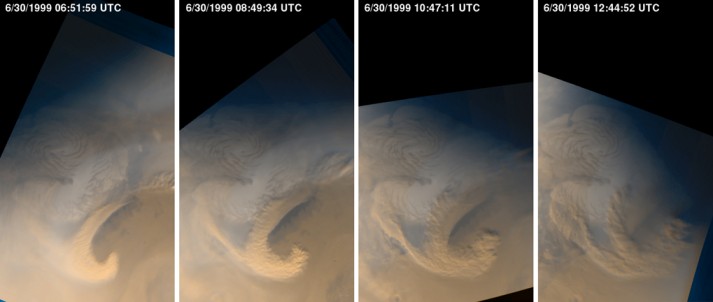
Mars may be a cold, dry planet but its weather is dynamic. On June 30, wide angle cameras on board the Mars Global Surveyor (MGS) spacecraft watched the development of this large scale storm system above Mars' north polar area. These frames were recorded on successive mapping orbits at intervals of about 2 hours, with the white north polar cap near the center of each. High winds seem to mix the brownish dust clouds and white water-ice clouds as the curling storm front churns over the extreme northern martain landscape. The MGS cameras have watched similar storms in this region during the months of July and August revealing surprisingly complex weather. Mars Climate Orbiter will join the MGS spacecraft in martian orbit in late September, and in December Mars Polar Lander is scheduled to touch down near the Red Planet's south pole.