Mars
Mars is the fourth planet from the Sun and the seventh largest in the Solar System. A cold, dusty desert world with a thin atmosphere (mostly CO₂), the planet features extinct volcanoes, deep canyons, polar ice caps, and seasons. Mars has two small moons (Phobos and Deimos), a day just over 24 hours long, and a year lasting about 687 Earth days. It is a prime focus of robotic exploration and studies about past water and habitability.
Source: science.nasa.gov
APODs including "Mars"
Sky and Planets
10/03/2000
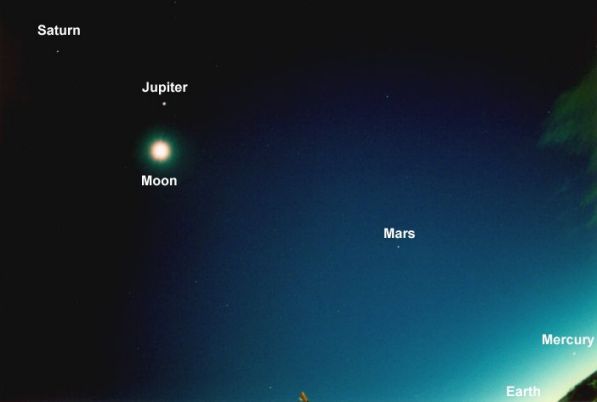
On February 10th, an evocative evening sky above Rocklin, California, USA inspired astrophotographer Steve Sumner to record this remarkable sight - five planets and the Moon. Near its first quarter phase, the bright Moon was intentionally overexposed but Saturn, Jupiter, Mars, and Mercury (and, of course, planet Earth's horizon) are all clearly visible in the deepening twilight. Notably absent in this grouping of naked-eye planets is Venus which is still putting in an early appearance as the morning star. This month, Mercury has joined Venus in the dawn twilight while Saturn, Jupiter, and Mars still shine brightly in the western sky at nightfall making another gorgeous close grouping with the crescent Moon.