Mars
Mars is the fourth planet from the Sun and the seventh largest in the Solar System. A cold, dusty desert world with a thin atmosphere (mostly CO₂), the planet features extinct volcanoes, deep canyons, polar ice caps, and seasons. Mars has two small moons (Phobos and Deimos), a day just over 24 hours long, and a year lasting about 687 Earth days. It is a prime focus of robotic exploration and studies about past water and habitability.
Source: science.nasa.gov
APODs including "Mars"
Inside Mars
23/03/2000
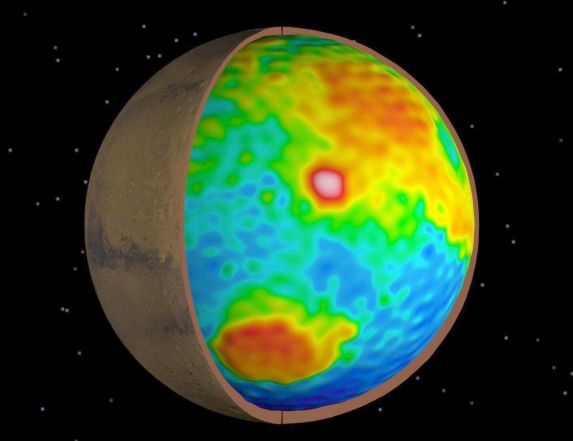
What's inside Mars? From orbit, the Mars Global Surveyor (MGS) spacecraft has recorded detailed images of the red planet since July 1997. Still, its cameras can not look beneath the surface. But minute changes in the spacecraft's orbital velocity are produced by variations in the planet's gravitational field, and these changes are related to interior density fluctuations. When the subtle orbital changes were measured using MGS radio science experiments and combined with the accurate Mars Orbiter Laser Altimeter topographical data, researchers were able to produce a map of the thickness of the martian crust. In this color cut-away diagram of the results, red colors correspond to thin and blue to thick areas of the crust which rides above the martian mantle. From the global map, the crust is seen to range from about 20 to 50 miles thick and shows a dramatic difference between the generally thinner northern hemisphere to thicker southern hemisphere crust. For the newly formed planet, the thin crust would have promoted rapid cooling and may have given rise to a large northern ocean on early Mars.