Mars
Mars is the fourth planet from the Sun and the seventh largest in the Solar System. A cold, dusty desert world with a thin atmosphere (mostly CO₂), the planet features extinct volcanoes, deep canyons, polar ice caps, and seasons. Mars has two small moons (Phobos and Deimos), a day just over 24 hours long, and a year lasting about 687 Earth days. It is a prime focus of robotic exploration and studies about past water and habitability.
Source: science.nasa.gov
APODs including "Mars"
Help NASA Classify Martian Craters
08/01/2001
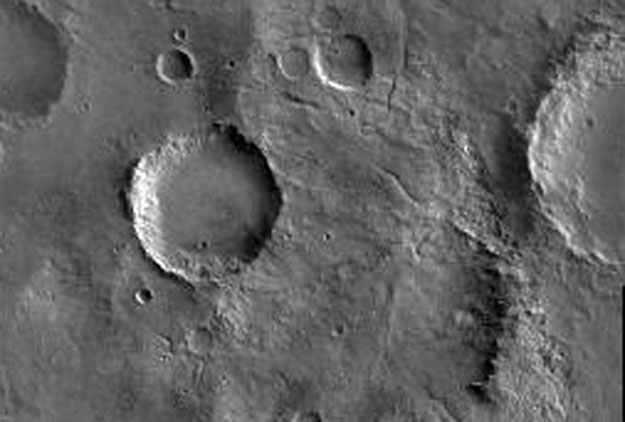
The large Martian crater above just left of center: is this a fresh crater, a degraded crater, or a ghost crater? Complex image recognition tasks like these are currently done more reliably by a human than a computer. Additionally, there are so many craters on Mars that NASA just doesn't have enough people to classify them all! Therefore, you can help humanity's understanding of the surface of Mars by volunteering to classify craters. All you need for this pilot study is a proper web browser and a mouse. If asked to classify the above crater, you might best respond that it appears relatively fresh, as it exhibits a sharp rim and a well-preserved interior. Degraded craters are typically older and have their rims more rounded, while "ghost craters" are the oldest of all and only faintly discernable.