Mars
Mars is the fourth planet from the Sun and the seventh largest in the Solar System. A cold, dusty desert world with a thin atmosphere (mostly CO₂), the planet features extinct volcanoes, deep canyons, polar ice caps, and seasons. Mars has two small moons (Phobos and Deimos), a day just over 24 hours long, and a year lasting about 687 Earth days. It is a prime focus of robotic exploration and studies about past water and habitability.
Source: science.nasa.gov
APODs including "Mars"
Deimos: A Small Martian Moon
02/09/2001
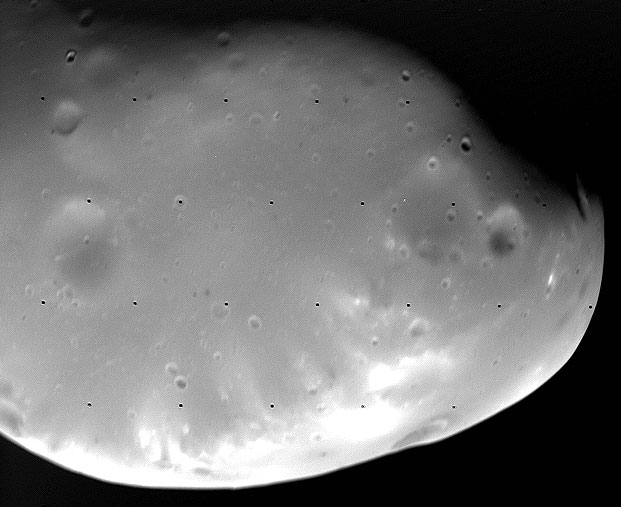
Mars has two tiny moons, Phobos and Deimos. Pictured above is Deimos, the smaller moon of Mars. In fact, Deimos is one of the smallest known moons in the Solar System measuring only nine miles across. The diminutive Martian moons were discovered in 1877 by Asaph Hall, an American astronomer working at the US Naval Observatory in Washington D.C. The existence of two Martian moons was predicted around 1610 by Johannes Kepler, the astronomer who derived the laws of planetary motion. In this case, Kepler's prediction was not based on scientific principles, but his writings and ideas were so influential that the two Martian moons are discussed in works of fiction such as Jonathan Swift's Gulliver's Travels, written in 1726, over 150 years before their actual discovery.