Mars
Mars is the fourth planet from the Sun and the seventh largest in the Solar System. A cold, dusty desert world with a thin atmosphere (mostly CO₂), the planet features extinct volcanoes, deep canyons, polar ice caps, and seasons. Mars has two small moons (Phobos and Deimos), a day just over 24 hours long, and a year lasting about 687 Earth days. It is a prime focus of robotic exploration and studies about past water and habitability.
Source: science.nasa.gov
APODs including "Mars"
Planets Over Stonehenge
09/05/2002
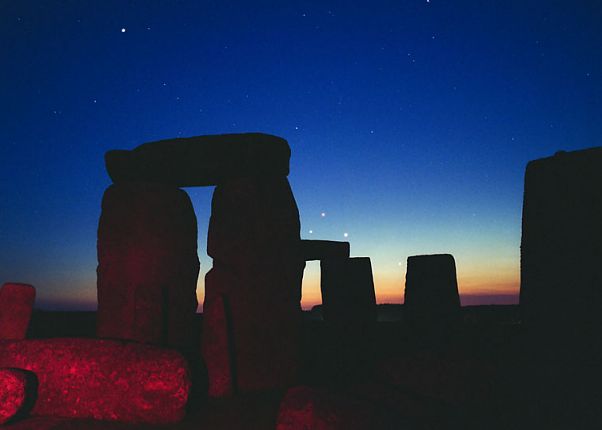
Stonehenge, four thousand year old monument to the Sun, provides an appropriate setting for this delightful snapshot of the Sun's children gathering in planet Earth's sky. While the massive stone structure dates from around 2000 B.C., this arrangement of the visible planets was recorded only a few days ago on the evening of May 4th, 2002 A.D. Bright Jupiter stands highest above the horizon at the upper left. A remarkable, almost equilateral triangle formed by Saturn (left), Mars (top), and Venus (right) is placed just above the stones near picture center. Fighting the glow of the setting sun, Mercury can be spotted closest to the horizon, below and right of the planetary triad. Still easy to enjoy for casual sky gazers, this photogenic and slowly shifting planetary grouping will be joined by a young crescent Moon beginning Monday, May 13.