Mars
Mars is the fourth planet from the Sun and the seventh largest in the Solar System. A cold, dusty desert world with a thin atmosphere (mostly CO₂), the planet features extinct volcanoes, deep canyons, polar ice caps, and seasons. Mars has two small moons (Phobos and Deimos), a day just over 24 hours long, and a year lasting about 687 Earth days. It is a prime focus of robotic exploration and studies about past water and habitability.
Source: science.nasa.gov
APODs including "Mars"
Night and Day in Melas Chasma on Mars
16/12/2002
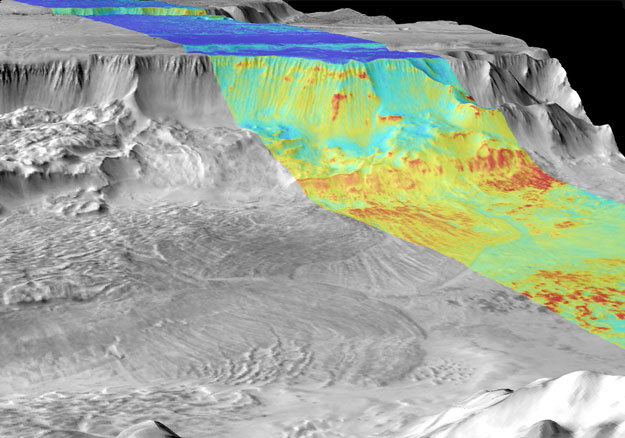
What types of terrain are found on Mars? Part of the answer comes from thermal imaging by the robot spacecraft 2001 Mars Odyssey currently orbiting Mars. The above picture is a superposition of two infrared images, a black and white image taken during Martian daylight and a false-color image taken at night. For the daytime image, dark colors mean cool temperatures, dropping from about -5 degrees Celsius to low as -35 degrees Celsius. Shadowed regions appear particularly dark, while grooved structure on the floor of Melas Chasma indicates successively overlapping landslides. In the nighttime swath, blue areas have cooled relatively quickly, indicating a composition of fine-grained dust and sand.