Mars
Mars is the fourth planet from the Sun and the seventh largest in the Solar System. A cold, dusty desert world with a thin atmosphere (mostly CO₂), the planet features extinct volcanoes, deep canyons, polar ice caps, and seasons. Mars has two small moons (Phobos and Deimos), a day just over 24 hours long, and a year lasting about 687 Earth days. It is a prime focus of robotic exploration and studies about past water and habitability.
Source: science.nasa.gov
APODs including "Mars"
Searching for Meteorites in Antarctica
26/12/2002
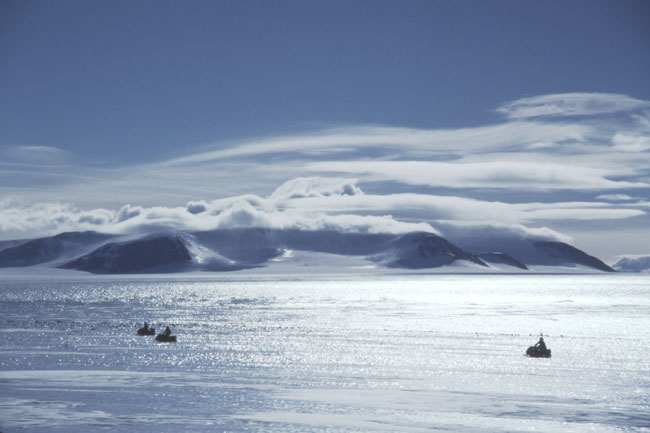
Where is the best place on Earth to find meteorites? Although meteors fall all over the world, they usually just sink to the bottom of an ocean, are buried by shifting terrain, or are easily confused with terrestrial rocks. At the bottom of the Earth, however, in East Antarctica, huge sheets of blue ice remain pure and barren. When traversing such a sheet, a dark rock will stick out. These rocks have a high probability of being true meteorites -- likely pieces of another world. An explosion or impact might have catapulted these meteorites from the Moon, Mars, or even an asteroid, yielding valuable information about these distant worlds and our early Solar System. Small teams of snowmobiling explorers so far have found thousands. Pictured above, ice-trekkers search a field 25-kilometers in front of Otway Massif in the Transantarctic Mountain Range during the Antarctic summer of 1995-1996.