Mars
Mars is the fourth planet from the Sun and the seventh largest in the Solar System. A cold, dusty desert world with a thin atmosphere (mostly CO₂), the planet features extinct volcanoes, deep canyons, polar ice caps, and seasons. Mars has two small moons (Phobos and Deimos), a day just over 24 hours long, and a year lasting about 687 Earth days. It is a prime focus of robotic exploration and studies about past water and habitability.
Source: science.nasa.gov
APODs including "Mars"
The Lost World of Lake Vida
28/01/2003
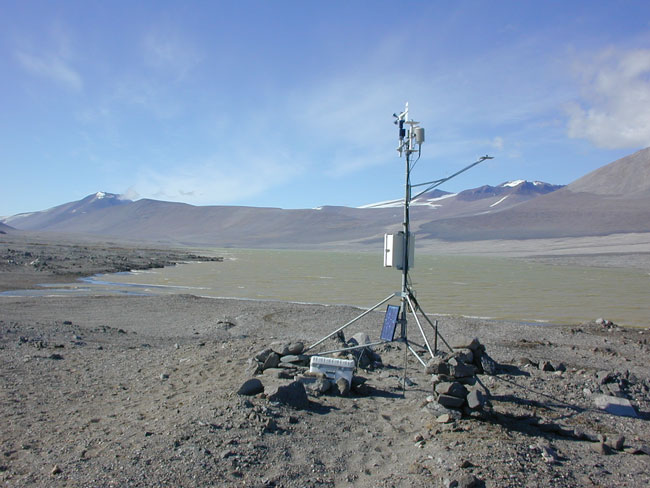
A lake hidden beneath 19 meters of ice and gravel has been found near the bottom of the world that might contain an ecosystem completely separate from our own. In a modern version of Sir Arthur Conan Doyle's classic book Lost World, scientists are now plotting a mission to drill down into the lake and take out a small part to see what's there. Lake Vida, buried under Antarctic ice for over 2,500 years, is liquid only because of its high salt content. Previously, scientists drilled to within a few meters of the lake and indeed found frozen microbes. Their existence bolsters speculation that similar microorganisms could be found in frozen brine beneath the surface of Mars. If living organisms are found in Lake Vida, they may give an indication that life might even still exist under similar frozen ice-sheets, such as under the larger Lake Vostok, parts of Mars, and even moons of Jupiter such as Europa. Pictured above, a robot meteorological station continues to monitor surface conditions over the ice-sealed lake.