Mars
Mars is the fourth planet from the Sun and the seventh largest in the Solar System. A cold, dusty desert world with a thin atmosphere (mostly CO₂), the planet features extinct volcanoes, deep canyons, polar ice caps, and seasons. Mars has two small moons (Phobos and Deimos), a day just over 24 hours long, and a year lasting about 687 Earth days. It is a prime focus of robotic exploration and studies about past water and habitability.
Source: science.nasa.gov
APODs including "Mars"
Magma Bubbles from Mt. Etna
16/04/2003
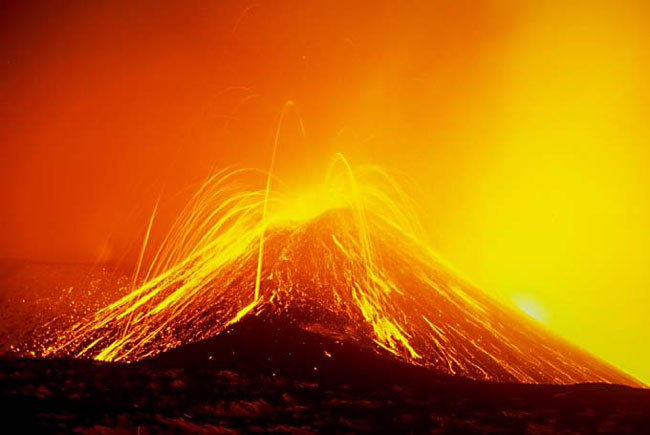
Mt. Etna erupted spectacularly in 2001 June. Pictured above, the volcano was photographed expelling bubbles of hot magma, some of which measured over one meter across. One reason planetary geologists study Earth's Mt. Etna is because of its likely similarity to volcanoes on Mars. Mt. Etna, a basalt volcano, is composed of material similar to Mars, and produces similar lava channels. Located in Sicily, Italy, Mt. Etna is not only one of the most active volcanoes on Earth, it is one of the largest, measuring over 50 kilometers at its base and rising nearly 3 kilometers high.