Mars
Mars is the fourth planet from the Sun and the seventh largest in the Solar System. A cold, dusty desert world with a thin atmosphere (mostly CO₂), the planet features extinct volcanoes, deep canyons, polar ice caps, and seasons. Mars has two small moons (Phobos and Deimos), a day just over 24 hours long, and a year lasting about 687 Earth days. It is a prime focus of robotic exploration and studies about past water and habitability.
Source: science.nasa.gov
APODs including "Mars"
Mars Through a Small Telescope
19/08/2003
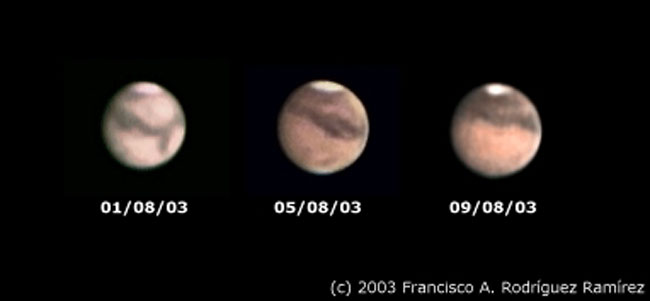
How does Mars appear through a small telescope? Viewed with the unaided eye or through a small telescope, possibly the most striking part of Mars' appearance is its red color. The color derives from rust, iron oxide, which composes perhaps 10% of the Martian soil. The oxygen that rusts the surface iron on Mars originates predominantly from carbon dioxide gas, which composes 95% of the Martian atmosphere. Mars nears its closest approach with Earth in nearly 60 millennia on August 27, the red planet continues to appear larger, brighter, and a good target for sky enthusiasts. Pictured above, Mars was captured from the Canary Islands of Spain during three days in three different orientations earlier this month. Visible through the small telescope are white polar caps of water and carbon-dioxide ice, light red areas rich in lightly colored craters, and dark red areas dominated by relatively smooth lowlands.