Mars
Mars is the fourth planet from the Sun and the seventh largest in the Solar System. A cold, dusty desert world with a thin atmosphere (mostly CO₂), the planet features extinct volcanoes, deep canyons, polar ice caps, and seasons. Mars has two small moons (Phobos and Deimos), a day just over 24 hours long, and a year lasting about 687 Earth days. It is a prime focus of robotic exploration and studies about past water and habitability.
Source: science.nasa.gov
APODs including "Mars"
Big Mars from Hubble
27/08/2003
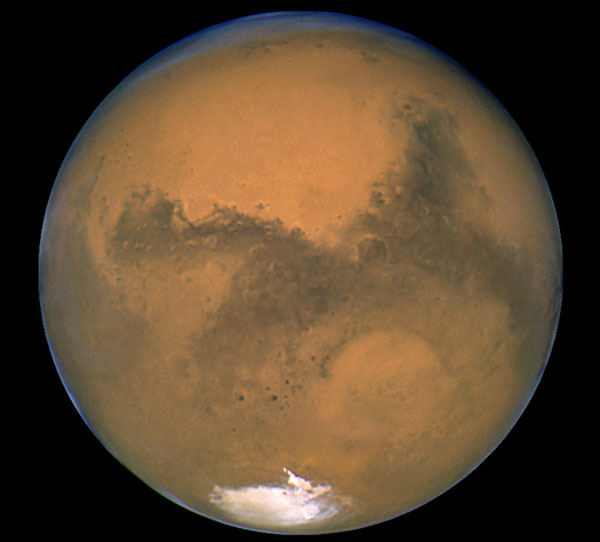
At about 10 am Universal Time today, Mars and Earth will pass closer than in nearly 60,000 years. Mars, noticeably red, will be the brightest object in the eastern sky just after sunset. Tonight and through much of this week, many communities around the world are running a public Mars Watch 2003 campaign, where local telescopes will zoom in on the red planet. Pictured above is an image of Mars taken just last night from the Hubble Space Telescope in orbit around the Earth. This image is the most detailed view of Mars ever taken from Earth. Visible features include the south polar cap in white at the image bottom, circular Huygens crater just to the right of the image center, Hellas Impact Basin - the large light circular feature at the lower right, planet-wide light highlands dominated by many smaller craters and large sweeping dark areas dominated by relatively smooth lowlands.