Mars
Mars is the fourth planet from the Sun and the seventh largest in the Solar System. A cold, dusty desert world with a thin atmosphere (mostly CO₂), the planet features extinct volcanoes, deep canyons, polar ice caps, and seasons. Mars has two small moons (Phobos and Deimos), a day just over 24 hours long, and a year lasting about 687 Earth days. It is a prime focus of robotic exploration and studies about past water and habitability.
Source: science.nasa.gov
APODs including "Mars"
Retrograde Mars
16/12/2003
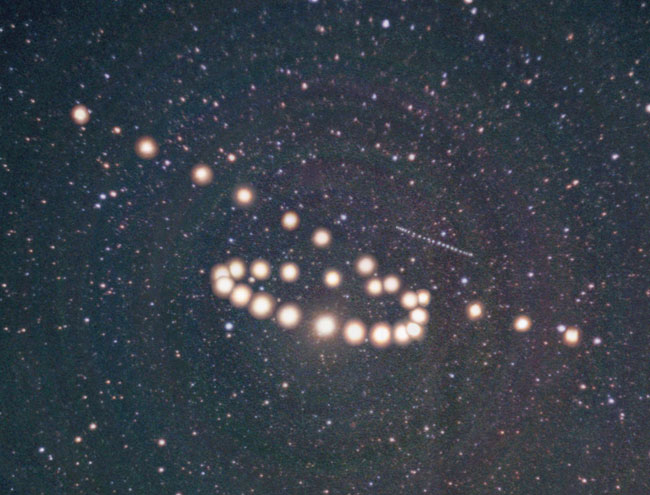
Why would Mars appear to move backwards? Most of the time, the apparent motion of Mars in Earth's sky is in one direction, slow but steady in front of the far distant stars. About every two years, however, the Earth passes Mars as they orbit around the Sun. During the most recent such pass in August, Mars loomed particularly large and bright. Also during this time, Mars appeared to move backwards in the sky, a phenomenon called retrograde motion. Pictured above is a series of images digitally stacked so that all of the stars images coincide. Here, Mars appears to trace out a loop in the sky. At the top of the loop, Earth passed Mars and the retrograde motion was the highest. Retrograde motion can also be seen for other Solar System planets. In fact, by coincidence, the dotted line to the right of the image center is Uranus doing the same thing.