Mars
Mars is the fourth planet from the Sun and the seventh largest in the Solar System. A cold, dusty desert world with a thin atmosphere (mostly CO₂), the planet features extinct volcanoes, deep canyons, polar ice caps, and seasons. Mars has two small moons (Phobos and Deimos), a day just over 24 hours long, and a year lasting about 687 Earth days. It is a prime focus of robotic exploration and studies about past water and habitability.
Source: science.nasa.gov
APODs including "Mars"
The Flight Of Helios
20/12/2003
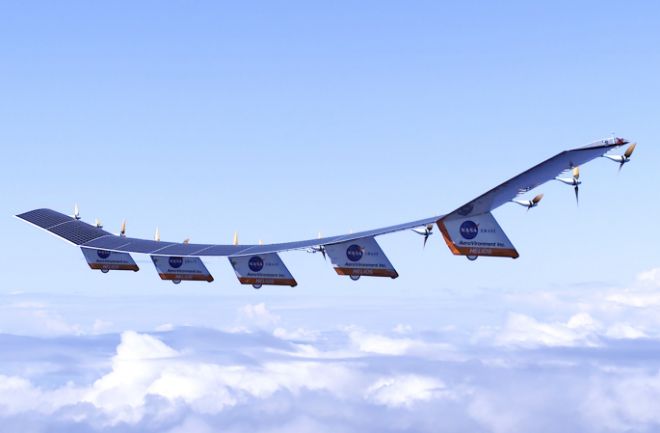
An example of solar-powered flight, NASA's Helios aircraft flew almost one hundred years after the Wright brothers' historic flight on December 17, 1903. Pictured here at 10,000 feet in in skies northwest of Kauai, Hawaii in August 2001, the remotely piloted Helios is traveling at about 25 miles per hour. Essentially an ultralight flying wing with 14 electric motors, the aircraft was built by AeroVironment Inc. Covered with solar cells, Helios' impressive 247 foot wide wing exceeded the wing span and even overall length of a Boeing 747 jet airliner. Climbing during daylight hours, the prototype aircraft ultimately reached an altitude just short of 100,000 feet, breaking records for non-rocket powered flight. Helios was intended as a technology demonstrator, but in the extremely thin air 100,000 feet above Earth's surface, the flight of Helios also approached conditions for winged flight in the atmosphere of Mars.