Mars
Mars is the fourth planet from the Sun and the seventh largest in the Solar System. A cold, dusty desert world with a thin atmosphere (mostly CO₂), the planet features extinct volcanoes, deep canyons, polar ice caps, and seasons. Mars has two small moons (Phobos and Deimos), a day just over 24 hours long, and a year lasting about 687 Earth days. It is a prime focus of robotic exploration and studies about past water and habitability.
Source: science.nasa.gov
APODs including "Mars"
Layered Hills on Mars
24/12/2003
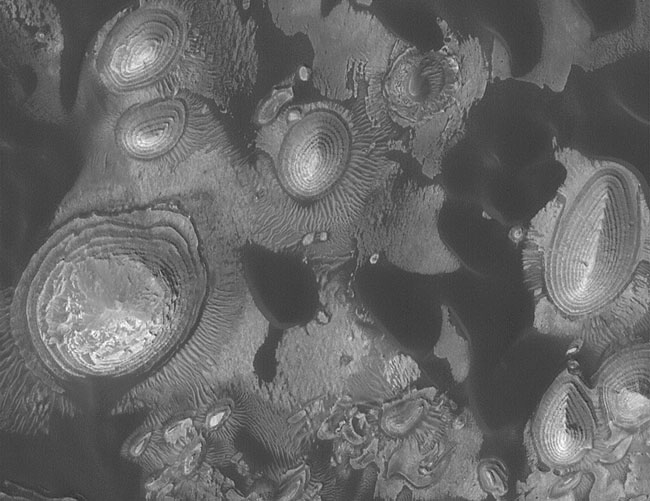
Why are some hills on Mars so layered? The answer is still under investigation. Clearly, dark windblown sand surrounds outcropping of light sedimentary rock across the floor of crater Arabia Terra. The light rock clearly appears structured into many layers, the lowest of which is likely very old. Although the dark sand forms dunes, rippled dunes of lighter colored sand are easier to see surrounding the stepped mesas. Blown sand possibly itself eroded once-larger mesas into the layered hills. Most of the layered shelves are wide enough to drive a truck around. The above image, showing an area about 3 kilometers across, was taken in October by the Mars Global Surveyor spacecraft currently orbiting Mars. Tomorrow, the first of three robot spacecraft from Earth is scheduled to arrive at the red planet.