Mars
Mars is the fourth planet from the Sun and the seventh largest in the Solar System. A cold, dusty desert world with a thin atmosphere (mostly CO₂), the planet features extinct volcanoes, deep canyons, polar ice caps, and seasons. Mars has two small moons (Phobos and Deimos), a day just over 24 hours long, and a year lasting about 687 Earth days. It is a prime focus of robotic exploration and studies about past water and habitability.
Source: science.nasa.gov
APODs including "Mars"
Columbia Memorial Station
22/01/2004
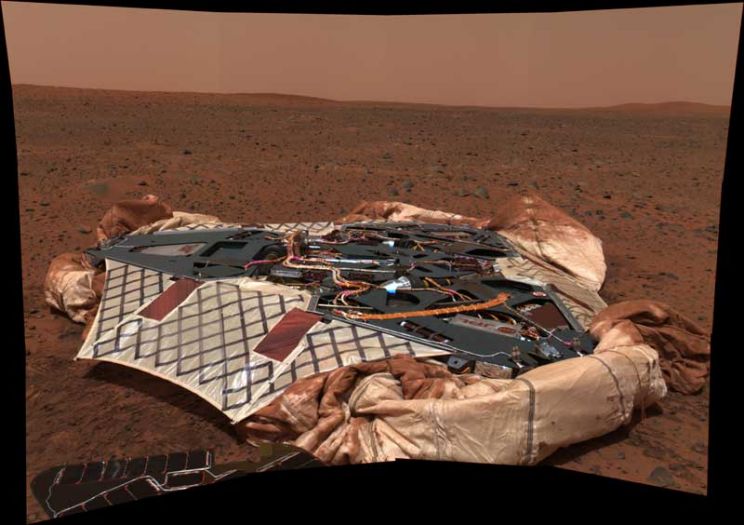
After leaving its nest, the Spirit rover turned to capture this spectacular view over the Columbia Memorial Station and the floor of Gusev crater on the 16th sol of its visit to Mars. The sharp picture looks toward the northeast. Over 2 meters wide, the lander platform surrounded by deflated airbags, and the egress ramp used by the rover to complete its journey to the martian surface, are in the foreground. In the background lie Spirit's likely future waypoints and destination - initially toward a ridge on the left bordering an impact crater about 200 meters across and finally toward the hills visible on the horizon at the right. The crater is about 250 meters away while the hills are about 3 kilometers distant. Searching for evidence of ancient watery environments, Spirit's scientific instruments have begun to return data on the composition of the surface in the lander's vicinity, suggesting that iron-bearing volcanic minerals are present.