Mars
Mars is the fourth planet from the Sun and the seventh largest in the Solar System. A cold, dusty desert world with a thin atmosphere (mostly CO₂), the planet features extinct volcanoes, deep canyons, polar ice caps, and seasons. Mars has two small moons (Phobos and Deimos), a day just over 24 hours long, and a year lasting about 687 Earth days. It is a prime focus of robotic exploration and studies about past water and habitability.
Source: science.nasa.gov
APODs including "Mars"
Humphrey Rock Indicates Ancient Martian Water
10/03/2004
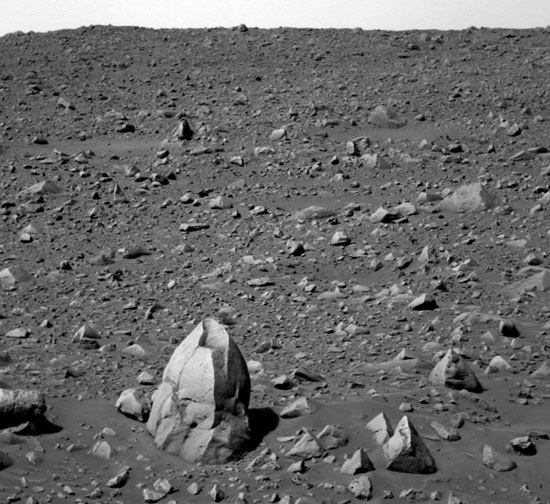
How prevalent was water on Mars? Results from the Spirit rover now indicate that Gusev crater likely had a wet past, a result that comes shortly after Spirit's twin rover Opportunity uncovered clear evidence of past water at Meridiani Planum on the other side of Mars. Evidence uncovered by Spirit and released last week focussed on a large rock of unusual shape nicknamed Humphrey, shown above near the image bottom. Detailed inspection of the rock revealed a bright material filling internal cracks. Such material may have crystallized from water trickling through the volcanic rock. The amount of Mars once covered by ancient water remains unknown, as both rovers landed in regions thought likely to once be underwater. Spirit continues to roll across Mars, recently passing the 300-meter mark on its way to Bonneville crater.