Mars
Mars is the fourth planet from the Sun and the seventh largest in the Solar System. A cold, dusty desert world with a thin atmosphere (mostly CO₂), the planet features extinct volcanoes, deep canyons, polar ice caps, and seasons. Mars has two small moons (Phobos and Deimos), a day just over 24 hours long, and a year lasting about 687 Earth days. It is a prime focus of robotic exploration and studies about past water and habitability.
Source: science.nasa.gov
APODs including "Mars"
Moon and Planets Sky
26/03/2004
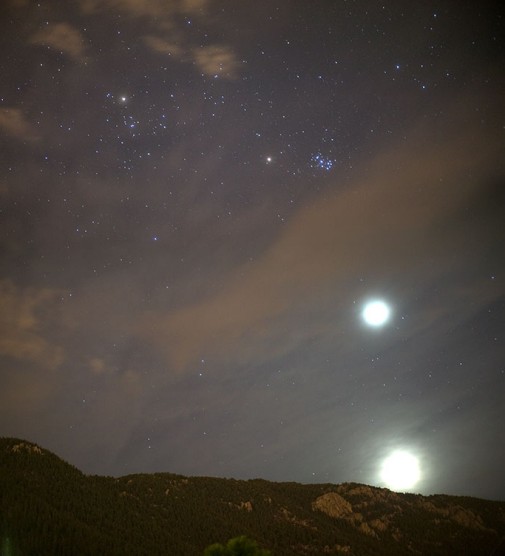
Look up into the sky tonight and without a telescope or binoculars you might have a view like this one of Moon, planets and stars. The lovely photo was taken on March 23rd, and captures the crescent Moon on the horizon with Venus above it. Both brilliant celestial bodies are over-exposed. Farther above Venus is the tinted glow of Mars with the Pleiades star cluster just to the red planet's right. The V-shaped arrangement of stars to the left of Mars is the Hydaes star cluster. Bright red giant Aldebaran, not itself a member of the Hyades cluster, marks the top left of the V. During the next week, all five naked-eye planets, Mercury, Venus, Mars, Jupiter, and Saturn, along with the Moon will grace the evening sky together - a lunar and planetary spectacle that can be enjoyed by skygazers around the world. But look just after sunset, low on the western horizon, to see Mercury before it sets. The next similar gathering of the planets will be in 2008.