Mars
Mars is the fourth planet from the Sun and the seventh largest in the Solar System. A cold, dusty desert world with a thin atmosphere (mostly CO₂), the planet features extinct volcanoes, deep canyons, polar ice caps, and seasons. Mars has two small moons (Phobos and Deimos), a day just over 24 hours long, and a year lasting about 687 Earth days. It is a prime focus of robotic exploration and studies about past water and habitability.
Source: science.nasa.gov
APODs including "Mars"
Unusual Plates on Mars
28/02/2005
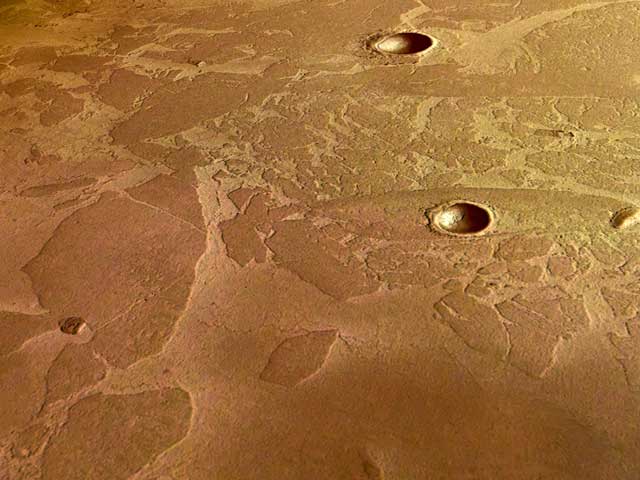
What are those unusual plates on Mars? A leading current interpretation holds that they are blocks of ice floating on a recently frozen sea covered by dust. The unusual plates were photographed recently by the European Space Agency's Mars Express spacecraft currently orbiting Mars. Oddly, the region lies near the Martian equator and not near either of Mars' frozen polar caps. Without being covered by dust, any water or ice near away from the poles would quickly evaporate right into the atmosphere. Evidence that the above-imaged plates really are dust-covered water-ice includes a similarity in appearance to ice blocks off Earth's Antarctica, nearby surface fractures from which underground water could have flowed, and the shallow depth of the craters indicating that something is filling them in. If correct, the low abundance of craters indicates that water may have flowed on Mars as recently as five million years ago.