Mars
Mars is the fourth planet from the Sun and the seventh largest in the Solar System. A cold, dusty desert world with a thin atmosphere (mostly CO₂), the planet features extinct volcanoes, deep canyons, polar ice caps, and seasons. Mars has two small moons (Phobos and Deimos), a day just over 24 hours long, and a year lasting about 687 Earth days. It is a prime focus of robotic exploration and studies about past water and habitability.
Source: science.nasa.gov
APODs including "Mars"
Reflections on the Inner Solar System
15/07/2005
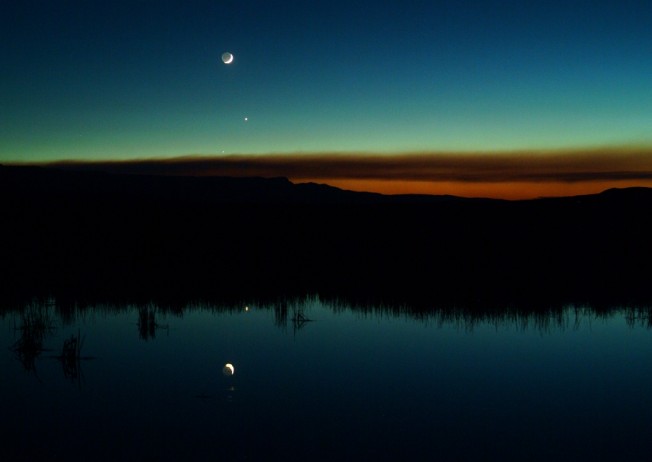
Only Mars is missing from this reflective view of the major rocky bodies of the inner solar system. Captured on July 8th, the serene, twilight picture looks out over the Flat Tops Wilderness area from near Toponas, Colorado, USA and includes planets Mercury, Venus, Earth, and Earth's large natural satellite, the Moon. The Moon is in a young crescent phase about three degrees above bright planet Venus. Forest fires contribute to a layer of smoke in Earth's sky that almost hides planet Mercury, still visible very near the horizon. Just a week earlier Venus and Mercury were joined by Saturn, forming a notable grouping in the west also enjoyed by skygazers across planet Earth.