Mars
Mars is the fourth planet from the Sun and the seventh largest in the Solar System. A cold, dusty desert world with a thin atmosphere (mostly CO₂), the planet features extinct volcanoes, deep canyons, polar ice caps, and seasons. Mars has two small moons (Phobos and Deimos), a day just over 24 hours long, and a year lasting about 687 Earth days. It is a prime focus of robotic exploration and studies about past water and habitability.
Source: science.nasa.gov
APODs including "Mars"
Water Ice in a Martian Crater
20/07/2005
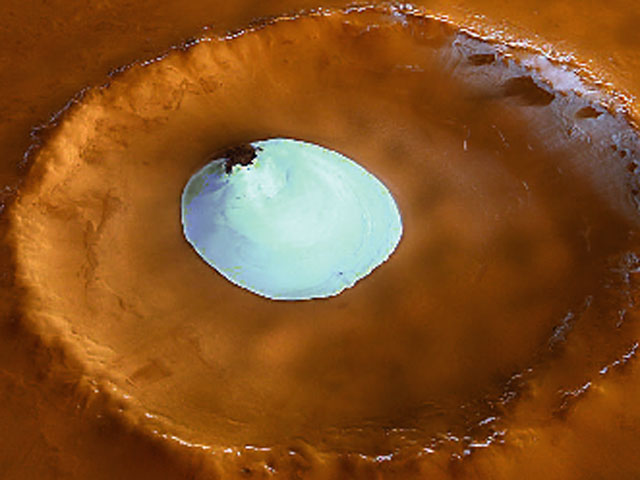
What lies on the floor of this Martian crater? A frozen patch of water ice. The robotic Mars Express spacecraft took the above image in early February. The ice pocket was found in a 35-kilometer wide crater that resides 70 degrees north of the Martian equator. There, sunlight is blocked by the 300-meter tall crater wall from vaporizing the water-ice on the crater floor into the thin Martian atmosphere. The ice pocket may be as deep as 200 meters thick. Frost can be seen around the inner edge on the upper right part of the crater, while part of the lower left crater wall is bathed in sunlight. The existence of water-ice pockets inside craters near the Martian North Pole, like that pictured above and others noted previously, give clues not only about surface conditions in the Martian past but also possible places where future water-based astronauts might do well to land.