Mars
Mars is the fourth planet from the Sun and the seventh largest in the Solar System. A cold, dusty desert world with a thin atmosphere (mostly CO₂), the planet features extinct volcanoes, deep canyons, polar ice caps, and seasons. Mars has two small moons (Phobos and Deimos), a day just over 24 hours long, and a year lasting about 687 Earth days. It is a prime focus of robotic exploration and studies about past water and habitability.
Source: science.nasa.gov
APODs including "Mars"
October Mars
28/10/2005
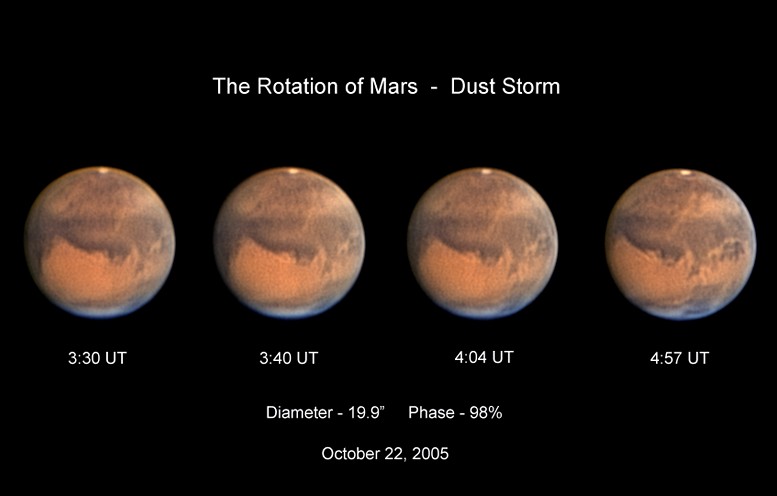
This October, Mars has become a bright, yellowish star in planet Earth's sky as it approaches oppositon, the period when Mars and Earth pass close as they orbit the Sun. How close is Mars? A mere 70 million kilometers or so, close enough to allow Earth-bound astronomers excellent views of the alluring Red Planet. For example, this series of sharp Mars images follows the development of a dust storm as the planet rotates from right to left. The telescopic views clearly show details of the martian surface, including the planet's southern ice cap (top) and hood of clouds over the north pole at the bottom edge. The dust storm itself is visible as a light yellowish band across an otherwise dark region in the southern hemisphere. Even if a telescope isn't handy, be sure to check out Mars soon. It will continue to shine brightly in the night over the coming days.