Mars
Mars is the fourth planet from the Sun and the seventh largest in the Solar System. A cold, dusty desert world with a thin atmosphere (mostly CO₂), the planet features extinct volcanoes, deep canyons, polar ice caps, and seasons. Mars has two small moons (Phobos and Deimos), a day just over 24 hours long, and a year lasting about 687 Earth days. It is a prime focus of robotic exploration and studies about past water and habitability.
Source: science.nasa.gov
APODs including "Mars"
Northern Spring on Mars
25/03/2006
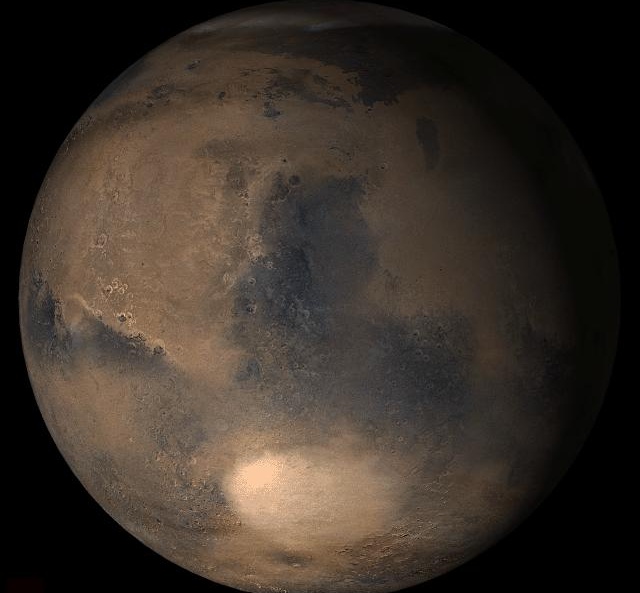
Astronomical spring came to planet Earth's northern hemisphere this week (and autumn to the south) with the equinox on March 20th. But on Mars, northern spring began on January 22nd. Still in northern springtime, the Red Planet currently has a similar appearance to this composite of images from previous years taken by the long-lasting Mars Global Surveyor spacecraft. The sprawling dark region near picture center is Syrtis Major, with the whitish Hellas impact basin just below, in the southern hemisphere. The four seasons on Earth each last about 90 earth days, while Mars' larger and more eccentric elliptical orbit results in seasons that are longer and vary more widely in length - from about 140 to 190 martian sols.