Mars
Mars is the fourth planet from the Sun and the seventh largest in the Solar System. A cold, dusty desert world with a thin atmosphere (mostly CO₂), the planet features extinct volcanoes, deep canyons, polar ice caps, and seasons. Mars has two small moons (Phobos and Deimos), a day just over 24 hours long, and a year lasting about 687 Earth days. It is a prime focus of robotic exploration and studies about past water and habitability.
Source: science.nasa.gov
APODs including "Mars"
Planets, Bees, and a Donkey
22/06/2006
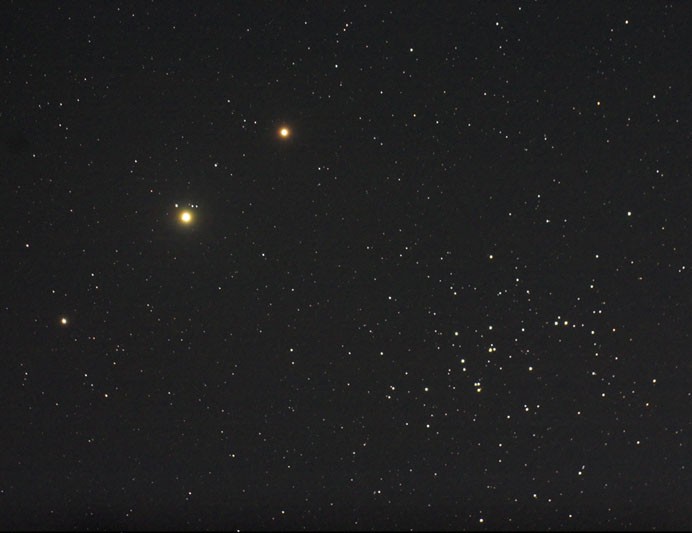
The heralded alignment of wandering planets Saturn and Mars with the well-known Beehive Cluster took place last weekend on Saturday, June 17. Recorded in dark Arizona skies on that date, this view finds Mars above and right of Saturn - the brightest celestial beacons in the scene - with the Beehive cluster of stars (M44) at the lower right. The two planets appear in conjunction separated by just over half a degree. But about another half a degree along a line joining the two and continuing towards the lower left lies the third brightest object in the image, giant star Asellus Australis. Asellus Australis is also known as Delta Cancri, a middling bright star 136 light-years away in the constellation Cancer, the Crab. Of course, this star's Latin name translates to "Southern Donkey".