Mars
Mars is the fourth planet from the Sun and the seventh largest in the Solar System. A cold, dusty desert world with a thin atmosphere (mostly CO₂), the planet features extinct volcanoes, deep canyons, polar ice caps, and seasons. Mars has two small moons (Phobos and Deimos), a day just over 24 hours long, and a year lasting about 687 Earth days. It is a prime focus of robotic exploration and studies about past water and habitability.
Source: science.nasa.gov
APODs including "Mars"
Eight Planets and New Solar System Designations
28/08/2006
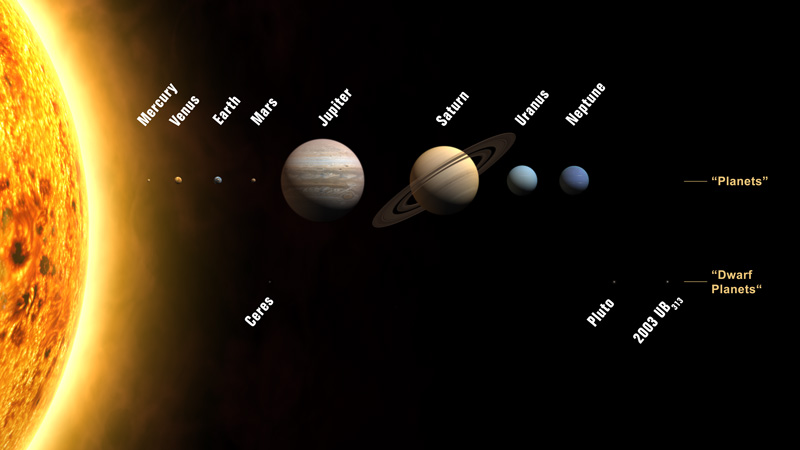
How many planets are in the Solar System? This popular question now has a new formal answer according the International Astronomical Union (IAU): eight. Last week, the IAU voted on a new definition for planet and Pluto did not make the cut. Rather, Pluto was re-classified as a dwarf planet and is considered as a prototype for a new category of trans-Neptunian objects. The eight planets now recognized by the IAU are: Mercury, Venus, Earth, Mars, Jupiter, Saturn, Uranus, and Neptune. Solar System objects now classified as dwarf planets are: Ceres, Pluto, and the currently unnamed 2003 UB313. Planets, by the new IAU definition, must be in orbit around the sun, be nearly spherical, and must have cleared the neighborhood around their orbits. The demotion of Pluto to dwarf planet status is a source of continuing dissent and controversy in the astronomical community.