Mars
Mars is the fourth planet from the Sun and the seventh largest in the Solar System. A cold, dusty desert world with a thin atmosphere (mostly CO₂), the planet features extinct volcanoes, deep canyons, polar ice caps, and seasons. Mars has two small moons (Phobos and Deimos), a day just over 24 hours long, and a year lasting about 687 Earth days. It is a prime focus of robotic exploration and studies about past water and habitability.
Source: science.nasa.gov
APODs including "Mars"
Beagle Crater on Mars
19/09/2006
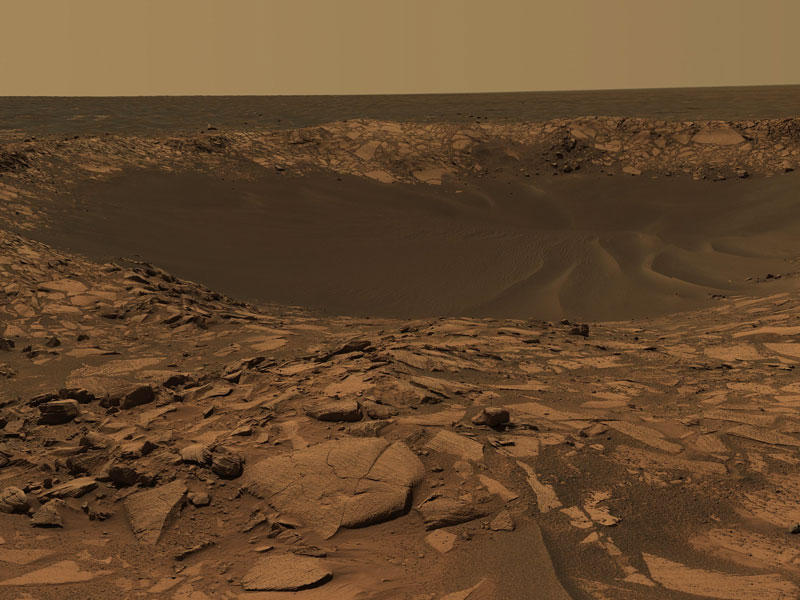
What have we found on the way to large Victoria Crater? Smaller Beagle Crater. The robotic Opportunity rover rolling across Mars stopped at Beagle Crater early last month and took an impressively detailed 360-degree panorama of the alien Martian landscape. Beagle crater appears in the center as a dip exposing relatively dark sand. Surrounding 35-meter Beagle Crater are many of the rocks ejected during its creation impact. Opportunity's detailed images show significant erosion on the rocks and walls of Beagle Crater, indicating that the crater is not fresh. Beagle Crater's unofficial name derives from the ship HMS Beagle where Charles Darwin observations led him to postulate his theory of natural selection. That ship was named after the dog breed of beagle. Opportunity is scheduled to roll up to expansive Victoria Crater this week.