Mars
Mars is the fourth planet from the Sun and the seventh largest in the Solar System. A cold, dusty desert world with a thin atmosphere (mostly CO₂), the planet features extinct volcanoes, deep canyons, polar ice caps, and seasons. Mars has two small moons (Phobos and Deimos), a day just over 24 hours long, and a year lasting about 687 Earth days. It is a prime focus of robotic exploration and studies about past water and habitability.
Source: science.nasa.gov
APODs including "Mars"
Children of the Sun
16/11/2006
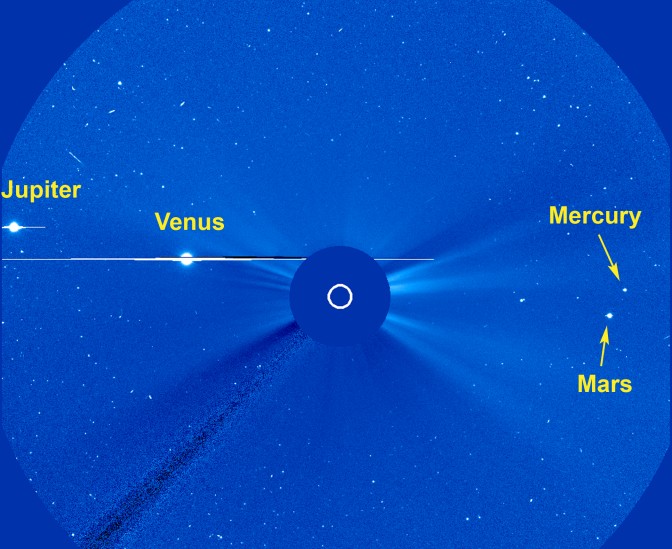
For a moment, planets Jupiter, Venus, Mars, and Mercury all posed near their parent star in this Sun-centered view, recorded on November 11. The picture, from a coronograph onboard the space-based SOlar Heliospheric Observatory, spans 15 degrees with the Sun's size and position indicated by the white circle. Background stars are also visible as the otherwise overwhelming sunlight is blocked by the coronograph's occulting disk. But the planets themselves, in particular Jupiter and Venus, are still bright enough to cause significant horizontal streaks in the image. Mercury is actually moving most rapidly (left to right) through the field and days earlier was seen to cross in front of the solar disk. So what's that bright double star to the left of Mars? Zubenelgenubi, of course.