Mars
Mars is the fourth planet from the Sun and the seventh largest in the Solar System. A cold, dusty desert world with a thin atmosphere (mostly CO₂), the planet features extinct volcanoes, deep canyons, polar ice caps, and seasons. Mars has two small moons (Phobos and Deimos), a day just over 24 hours long, and a year lasting about 687 Earth days. It is a prime focus of robotic exploration and studies about past water and habitability.
Source: science.nasa.gov
APODs including "Mars"
A Year of Extraterrestrial Fountains and Flows
31/12/2006
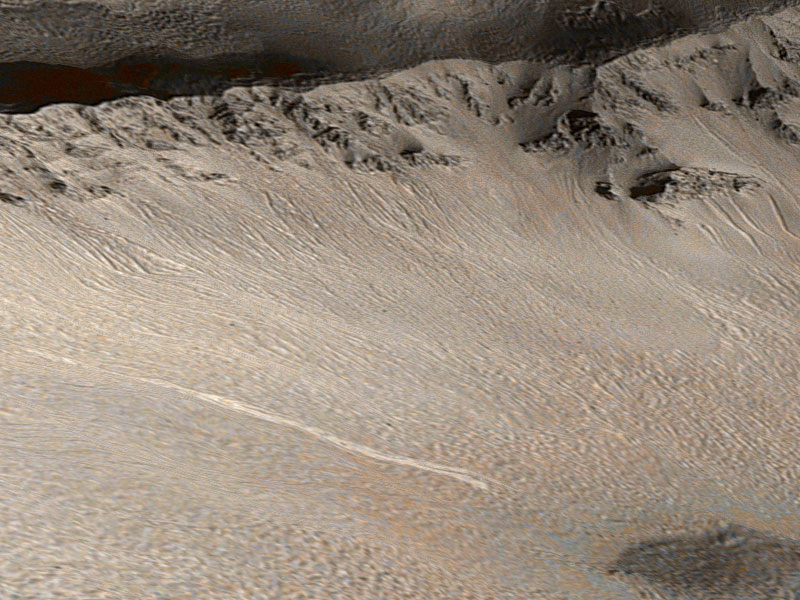
The past year was extraordinary for the discovery of extraterrestrial fountains and flows -- some offering new potential in the search for liquid water and the origin of life beyond planet Earth.. Increased evidence was uncovered that fountains spurt not only from Saturn's moon Enceladus, but from the dunes of Mars as well. Lakes were found on Saturn's moon Titan, and the residual of a flowing liquid was discovered on the walls of Martian craters. The diverse Solar System fluidity may involve forms of slushy water-ice, methane, or sublimating carbon dioxide. Pictured above, the light-colored path below the image center is hypothesized to have been created sometime in just the past few years by liquid water flowing across the surface of Mars.