Mars
Mars is the fourth planet from the Sun and the seventh largest in the Solar System. A cold, dusty desert world with a thin atmosphere (mostly CO₂), the planet features extinct volcanoes, deep canyons, polar ice caps, and seasons. Mars has two small moons (Phobos and Deimos), a day just over 24 hours long, and a year lasting about 687 Earth days. It is a prime focus of robotic exploration and studies about past water and habitability.
Source: science.nasa.gov
APODs including "Mars"
Small Worlds Ceres and Vesta
22/06/2007
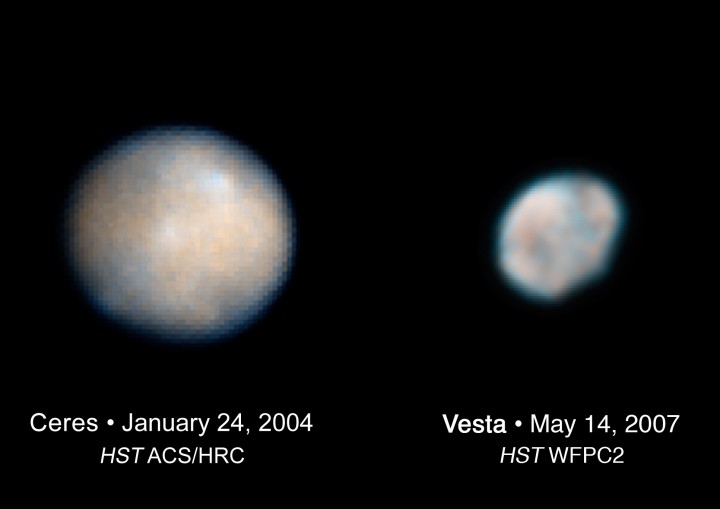
Ceres and Vesta are, respectively, only around 950 kilometers and 530 kilometers in diameter - about the size of Texas and Arizona. But they are two of the largest of over 100,000 minor bodies orbiting in the main asteroid belt between Mars and Jupiter. These remarkably detailed Hubble Space Telescope images show brightness and color variations across the surface of the two small worlds. The variations could represent large scale surface features or areas of different compositon. The Hubble image data will help astronomers plan for a visit by the asteroid-hopping Dawn spacecraft, scheduled for launch on July 7 and intended to orbit first Vesta and then Ceres after a four year interplanetary cruise. Though Shakespeare might not have been impressed, nomenclature introduced by the International Astronomical Union in 2006 classifies nearly spherical Ceres as a dwarf planet.