Mars
Mars is the fourth planet from the Sun and the seventh largest in the Solar System. A cold, dusty desert world with a thin atmosphere (mostly CO₂), the planet features extinct volcanoes, deep canyons, polar ice caps, and seasons. Mars has two small moons (Phobos and Deimos), a day just over 24 hours long, and a year lasting about 687 Earth days. It is a prime focus of robotic exploration and studies about past water and habitability.
Source: science.nasa.gov
APODs including "Mars"
A Hole in Mars Close Up
28/09/2007
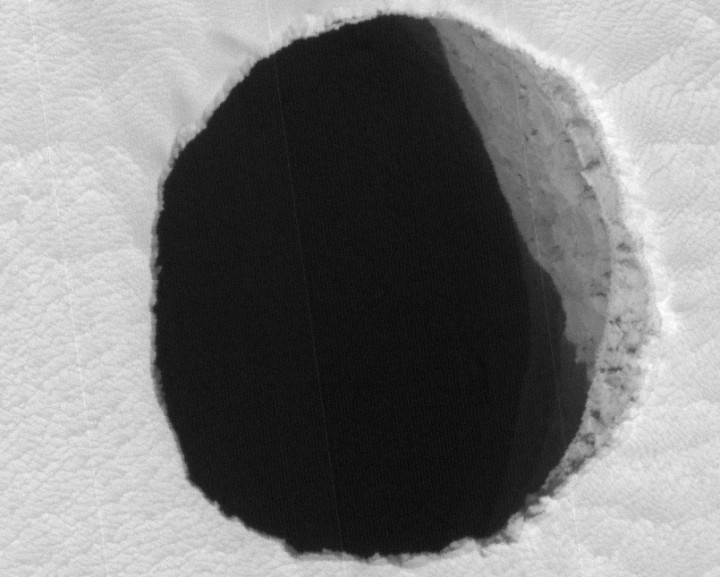
In a close-up from the HiRISE instrument onboard the Mars Reconnaissance Orbiter, this mysterious dark pit, about 150 meters across, lies on the north slope of ancient martian volcano Arsia Mons. Lacking raised rims and other impact crater characteristics, this pit and others like it were originally identified in visible light and infrared images from the Mars Odyssey and Mars Global Surveyor spacecraft. While the visible light images showed only darkness within, infrared thermal signatures indicated that the openings penetrated deep under the martian surface and perhaps were skylights to underground caverns. In this later image, the pit wall is partially illuminated by sunlight and seen to be nearly vertical, though the bottom, at least 78 meters below, is still not visible. The dark martian pits are thought to be related to collapse pits in the lava flow, similar to Hawaiian volcano pit craters.