Mars
Mars is the fourth planet from the Sun and the seventh largest in the Solar System. A cold, dusty desert world with a thin atmosphere (mostly CO₂), the planet features extinct volcanoes, deep canyons, polar ice caps, and seasons. Mars has two small moons (Phobos and Deimos), a day just over 24 hours long, and a year lasting about 687 Earth days. It is a prime focus of robotic exploration and studies about past water and habitability.
Source: science.nasa.gov
APODs including "Mars"
Bright Planets, Crescent Moon
11/10/2007
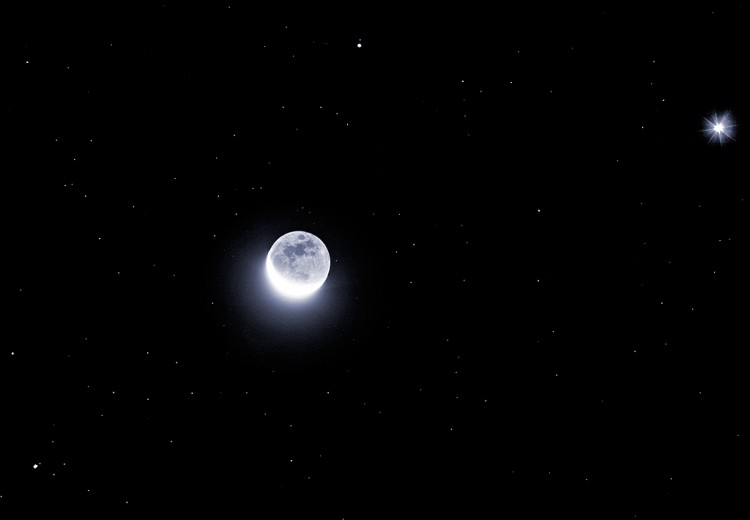
rly risers are currently enjoying the sight of dazzling Venus, near the eastern horizon as the morning star. Recorded on October 7, this predawn skyview does feature Venus at the upper right. It also includes a crescent Moon and Saturn (lower left). In fact, holding your fist at arms length would have easily covered both planets and the Moon in this 5 degree wide field. Earthshine, sunlight reflected from planet Earth's dayside, illuminates features on the lunar nightside. A close inspection of Saturn itself reveals a nearby pinpoint of light corresponding to Saturn's large moon Titan. Though the Moon has moved on, the tight triangle formed by Venus, Saturn, and Regulus (top), alpha star in the constellation Leo, will continue to look impressive in early morning skies over the next few days. Early bird astrophotographer Jay Ouellet also described Mars as a "brilliant red diode" in his dark country sky east of Quebec City, Canada. Count the Stars: The Great World Wide Star Count