Mars
Mars is the fourth planet from the Sun and the seventh largest in the Solar System. A cold, dusty desert world with a thin atmosphere (mostly CO₂), the planet features extinct volcanoes, deep canyons, polar ice caps, and seasons. Mars has two small moons (Phobos and Deimos), a day just over 24 hours long, and a year lasting about 687 Earth days. It is a prime focus of robotic exploration and studies about past water and habitability.
Source: science.nasa.gov
APODs including "Mars"
Layers in Aureum Chaos
04/04/2008
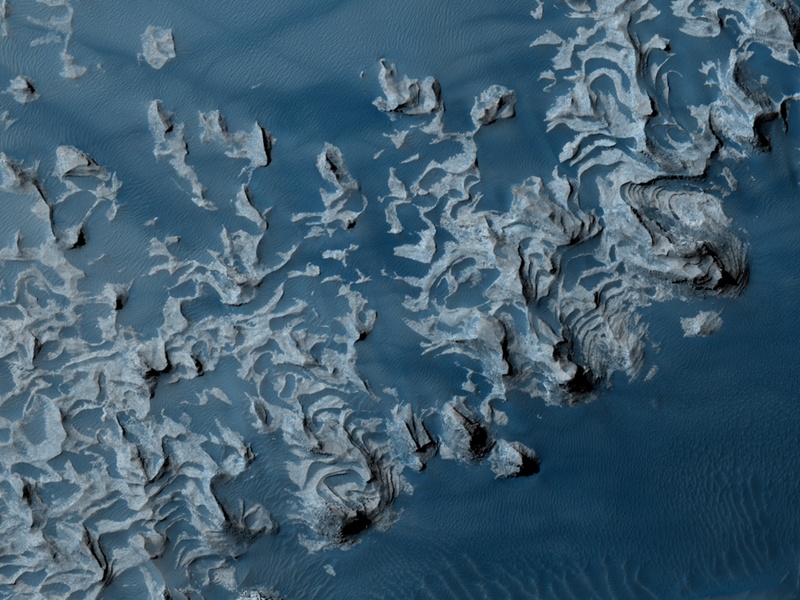
At first glance these undulating shapes in shades of blue might look like waves on an ocean. Seen here in a false-color image from the Mars Reconnaissance Orbiter's HiRISE camera, they are actually layered rock outcrops found in Aureum Chaos. The larger Aureum Chaos region is a chaotic jumble of eroded terrain in the eastern part of Mars' immense canyon Valles Marineris. Distinct layers composing these outcrops could have been laid down by dust or volcanic ash settling from the atmosphere, sand carried by martian winds, or sediments deposited on the floor of an ancient lake. This close-up view of the otherwise red planet spans about 4 kilometers, a distance you might walk over flat ground in less than an hour.