Mars
Mars is the fourth planet from the Sun and the seventh largest in the Solar System. A cold, dusty desert world with a thin atmosphere (mostly CO₂), the planet features extinct volcanoes, deep canyons, polar ice caps, and seasons. Mars has two small moons (Phobos and Deimos), a day just over 24 hours long, and a year lasting about 687 Earth days. It is a prime focus of robotic exploration and studies about past water and habitability.
Source: science.nasa.gov
APODs including "Mars"
Unusual Light Patch Under Phoenix Lander on Mars
02/06/2008
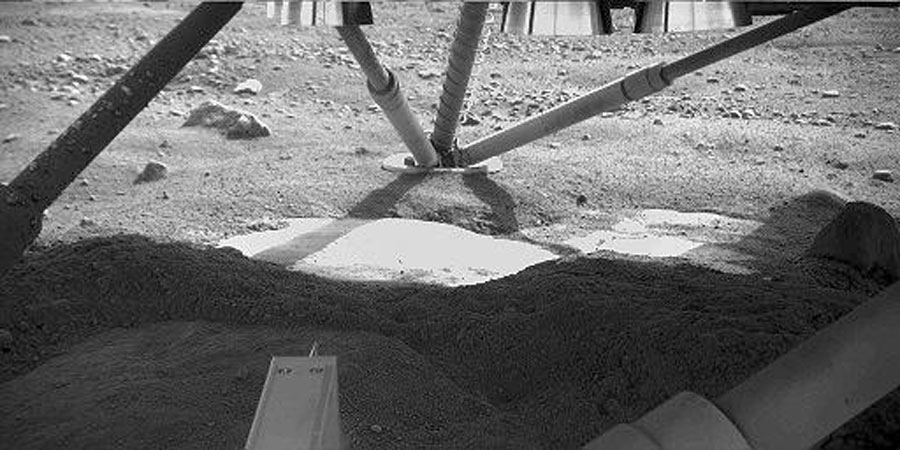
Is that ice under the Phoenix spacecraft on Mars? Quite possibly. Phoenix, which landed a week ago, was expected to dig under the Martian soil to search for ice, but the lander's braking rockets may already have uncovered some during descent. Pictured above is an image taken last week by the Robotic Arm Camera showing the unusual light-colored substance just in front of Phoenix's landing pad. Over the next few weeks, Phoenix will continue to photograph its surroundings, analyze the composition of this hard light substrate, and dig into the surrounding soil. Were the unusual light substrate indeed Martian ice, it would give Phoenix a convenient pedestal to investigate the history of water on Mars, and to better determine whether the boundary between ice and soil was ever capable of supporting life.