Mars
Mars is the fourth planet from the Sun and the seventh largest in the Solar System. A cold, dusty desert world with a thin atmosphere (mostly CO₂), the planet features extinct volcanoes, deep canyons, polar ice caps, and seasons. Mars has two small moons (Phobos and Deimos), a day just over 24 hours long, and a year lasting about 687 Earth days. It is a prime focus of robotic exploration and studies about past water and habitability.
Source: science.nasa.gov
APODs including "Mars"
Layers of Red Cliffs on Mars
06/10/2008
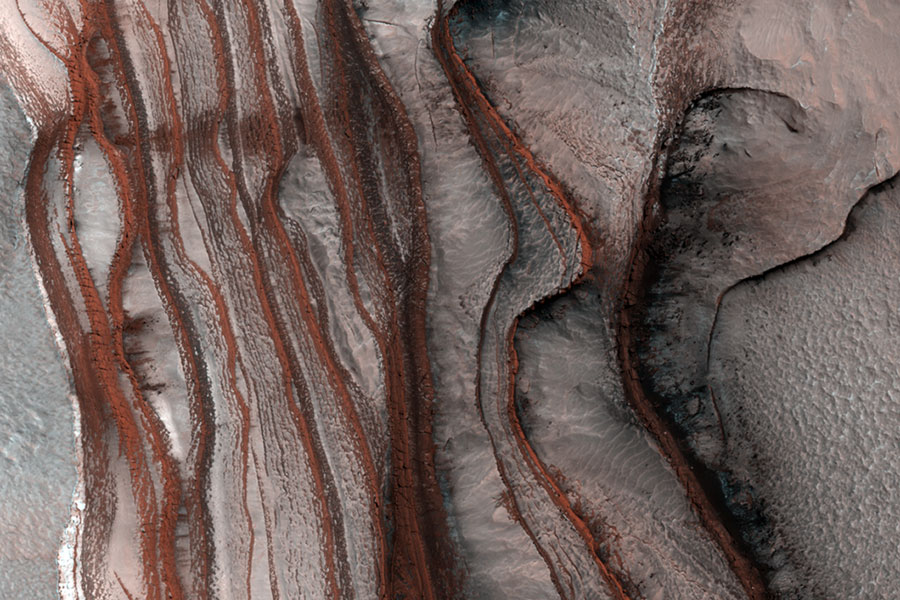
How did these layers of red cliffs form on Mars? No one is sure. The northern ice cap on Mars is nearly divided into two by a huge division named Chasma Boreale. No similar formation occurs on Earth. Pictured above, several dusty layers leading into this deep chasm are visible. Cliff faces, mostly facing left but still partly visible from above, appear dramatically red. The light areas are likely water ice. The above image spans about one kilometer near the north of Mars, and the elevation drop from right to left is over a kilometer. One hypothesis relates the formation of Chasma Boreale to underlying volcanic activity.