Mars
Mars is the fourth planet from the Sun and the seventh largest in the Solar System. A cold, dusty desert world with a thin atmosphere (mostly CO₂), the planet features extinct volcanoes, deep canyons, polar ice caps, and seasons. Mars has two small moons (Phobos and Deimos), a day just over 24 hours long, and a year lasting about 687 Earth days. It is a prime focus of robotic exploration and studies about past water and habitability.
Source: science.nasa.gov
APODs including "Mars"
Jupiter Over the Mediterranean
07/09/2009
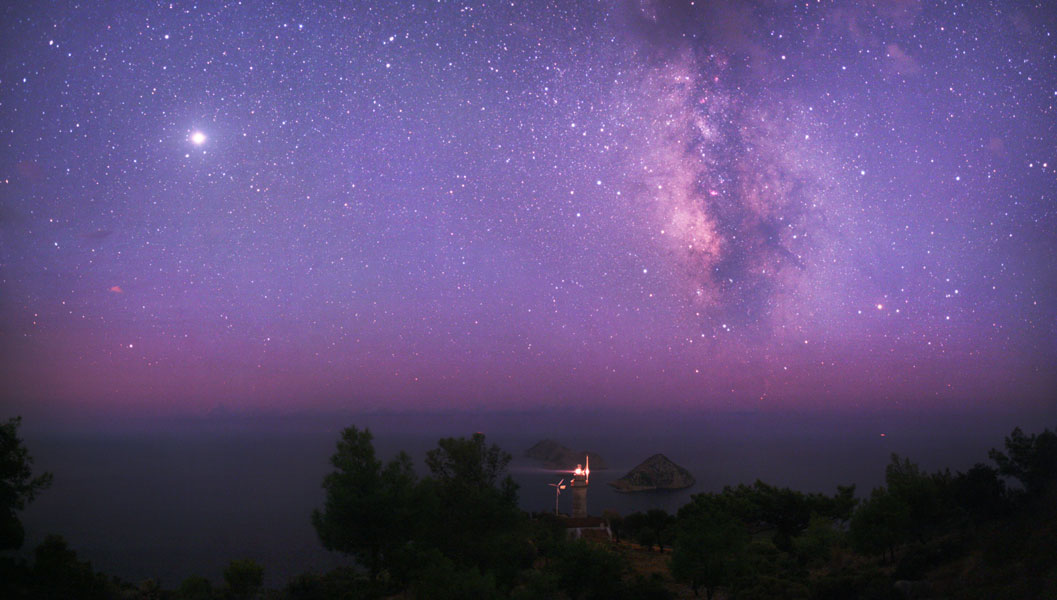
This vacation included a sight to remember. Pictured above, a picturesque starscape capped a serene seascape as seen from Turkey this past August. In the above digitally stitched panorama, the Gelidonya Lighthouse shines in the foreground before a calm Mediterranean Sea. On the left, Jupiter is the brightest point in the image and since on the same side of the Sun as the Earth, was near its yearly brightest. Glowing just shy of magnitude -3, Jupiter was brighter than any star in the sky, and brighter even than Mars was during its famously bright opposition of 2003 August. On the right, the band of the Milky Way Galaxy fades into distant atmospheric haze above the horizon. Jupiter is nearing the closest part of its elliptical orbit to the Sun and so will appear even brighter during its next opposition in 2010 September.