Mars
Mars is the fourth planet from the Sun and the seventh largest in the Solar System. A cold, dusty desert world with a thin atmosphere (mostly CO₂), the planet features extinct volcanoes, deep canyons, polar ice caps, and seasons. Mars has two small moons (Phobos and Deimos), a day just over 24 hours long, and a year lasting about 687 Earth days. It is a prime focus of robotic exploration and studies about past water and habitability.
Source: science.nasa.gov
APODs including "Mars"
Slope Streaks in Acheron Fossae on Mars
01/03/2010
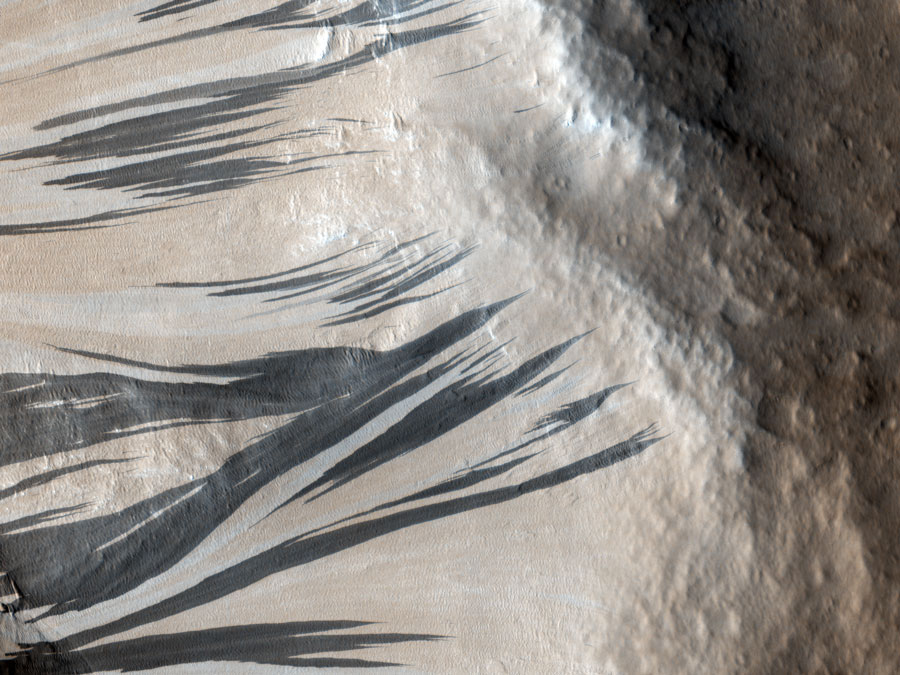
What creates these picturesque dark streaks on Mars? No one knows for sure. A leading hypothesis is that streaks like these are caused by fine grained sand sliding down the banks of troughs and craters. Pictured above, dark sand appears to have flowed hundreds of meters down the slopes of Acheron Fossae. The sand appears to flow like a liquid around boulders, and, for some reason, lightens significantly over time. This sand flow process is one of several which can rapidly change the surface of Mars, with other processes including dust devils, dust storms, and the freezing and melting of areas of ice. The above image was taken by the HiRise camera on board the Mars Reconnaissance Orbiter which has been orbiting Mars since 2006. Acheron Fossae is a 700 kilometer long trough in the Diacria quadrangle of Mars.