Mars
Mars is the fourth planet from the Sun and the seventh largest in the Solar System. A cold, dusty desert world with a thin atmosphere (mostly CO₂), the planet features extinct volcanoes, deep canyons, polar ice caps, and seasons. Mars has two small moons (Phobos and Deimos), a day just over 24 hours long, and a year lasting about 687 Earth days. It is a prime focus of robotic exploration and studies about past water and habitability.
Source: science.nasa.gov
APODs including "Mars"
A Dark Dune Field in Proctor Crater on Mars
22/11/2010
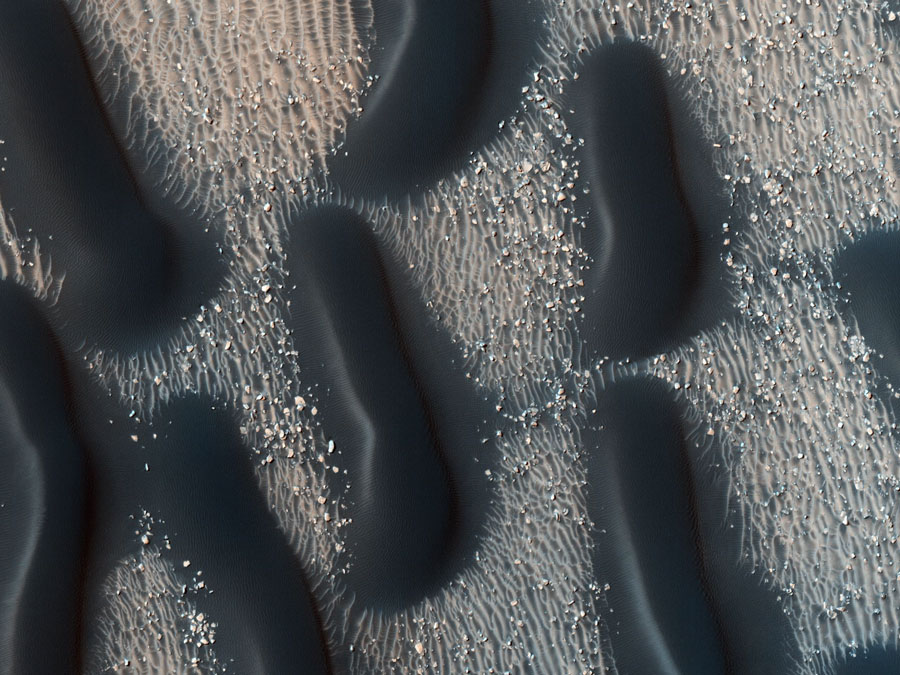
Was this image taken with a telescope or a microscope? Perhaps this clue will help: if the dark forms were bacteria, they would each span over football field across. What is actually being seen are large sand dunes on the floor of Proctor Crater on Mars. The above picture was taken by HiRISE camera on board the Mars Reconnaissance Orbiter (MRO), a robot spacecraft currently in orbit around Mars. The dark rippled dunes likely formed more recently than the lighter rock forms they appear to cover, and are thought to slowly shift in response to pervasive winds. The dunes arise from a complex relationship between the sandy surface and high winds on Mars. Similar dunes were first seen in Proctor Crater by Mariner 9 more than 35 years ago. Challenge: Can you find a microscopic picture that resembles this astronomical one?