Mars
Mars is the fourth planet from the Sun and the seventh largest in the Solar System. A cold, dusty desert world with a thin atmosphere (mostly CO₂), the planet features extinct volcanoes, deep canyons, polar ice caps, and seasons. Mars has two small moons (Phobos and Deimos), a day just over 24 hours long, and a year lasting about 687 Earth days. It is a prime focus of robotic exploration and studies about past water and habitability.
Source: science.nasa.gov
APODs including "Mars"
A Mars Panorama from the Phoenix Lander
13/03/2011
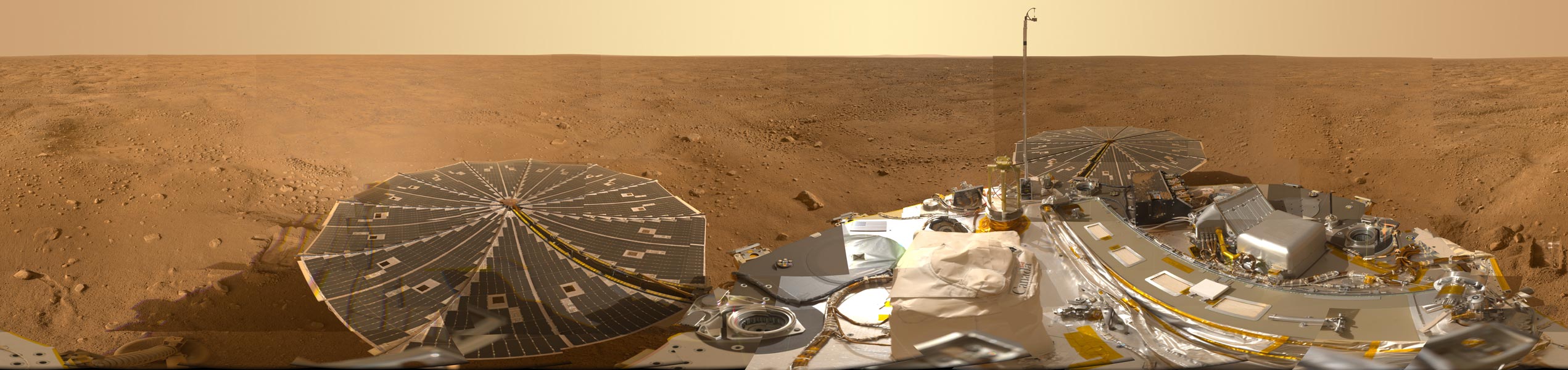
If you could stand on Mars, what would you see? The robotic Phoenix spacecraft that landed on Mars in 2008 recorded the above spectacular panorama. The above image is actually a digital combination of over 100 camera pointings and surveys fully 360 degrees around the busy robotic laboratory. Scrolling right will reveal the rest of the panoramic image. Visible in the image foreground are circular solar panels, various Phoenix instruments, rust colored rocks, a trench dug by Phoenix to probe Mars' chemical composition, a vast plateau of dirt and dirt-covered ice, and, far in the distance, the dust colored atmosphere of Mars. Phoenix landed in the far north of Mars and has used its sophisticated laboratory to search for signs that past life might have been possible. Soil analyses have confirmed the presence of ice and gave unexpected indications of perchlorate salts. Whether Martian life could have evolved around such perchlorates is an ongoing topic of research.