Mars
Mars is the fourth planet from the Sun and the seventh largest in the Solar System. A cold, dusty desert world with a thin atmosphere (mostly CO₂), the planet features extinct volcanoes, deep canyons, polar ice caps, and seasons. Mars has two small moons (Phobos and Deimos), a day just over 24 hours long, and a year lasting about 687 Earth days. It is a prime focus of robotic exploration and studies about past water and habitability.
Source: science.nasa.gov
APODs including "Mars"
Conjunction Colours
23/08/2012
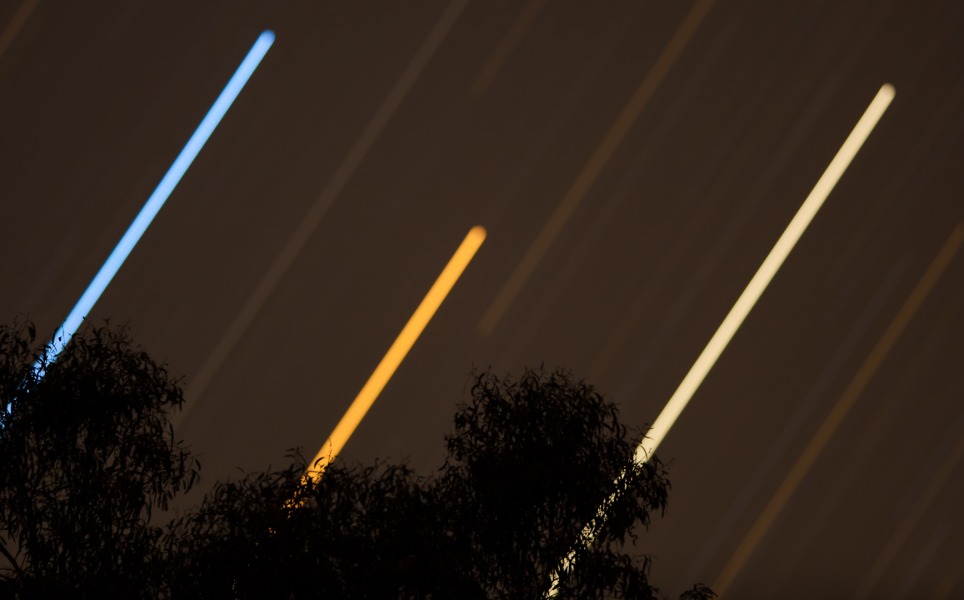
During the past week, nightfall on planet Earth has featured Mars, Saturn, and Spica in a lovely conjunction near the western horizon. Still forming the corners of a distinctive celestial triangle after sunset and recently joined by a crescent Moon, they are all about the same brightness but can exhibit different colors to the discerning eye. This ingenious star trail image was recorded as the trio set on August 12 with a telephoto lens from the shores of Lake Eppalock, in central Victoria, Australia. Focused on foreground eucalyptus trees, the image slightly blurs the trails to show more saturated colors. Can you guess which trail is which? Of course the reddest trail is Mars, with Saturn on the right a paler echo of the Red Planet's hue. Left is hot and luminous Spica, bluish alpha star of the constellation Virgo.