Mars
Mars is the fourth planet from the Sun and the seventh largest in the Solar System. A cold, dusty desert world with a thin atmosphere (mostly CO₂), the planet features extinct volcanoes, deep canyons, polar ice caps, and seasons. Mars has two small moons (Phobos and Deimos), a day just over 24 hours long, and a year lasting about 687 Earth days. It is a prime focus of robotic exploration and studies about past water and habitability.
Source: science.nasa.gov
APODs including "Mars"
Dry Ice Sled Streaks on Mars
17/06/2013
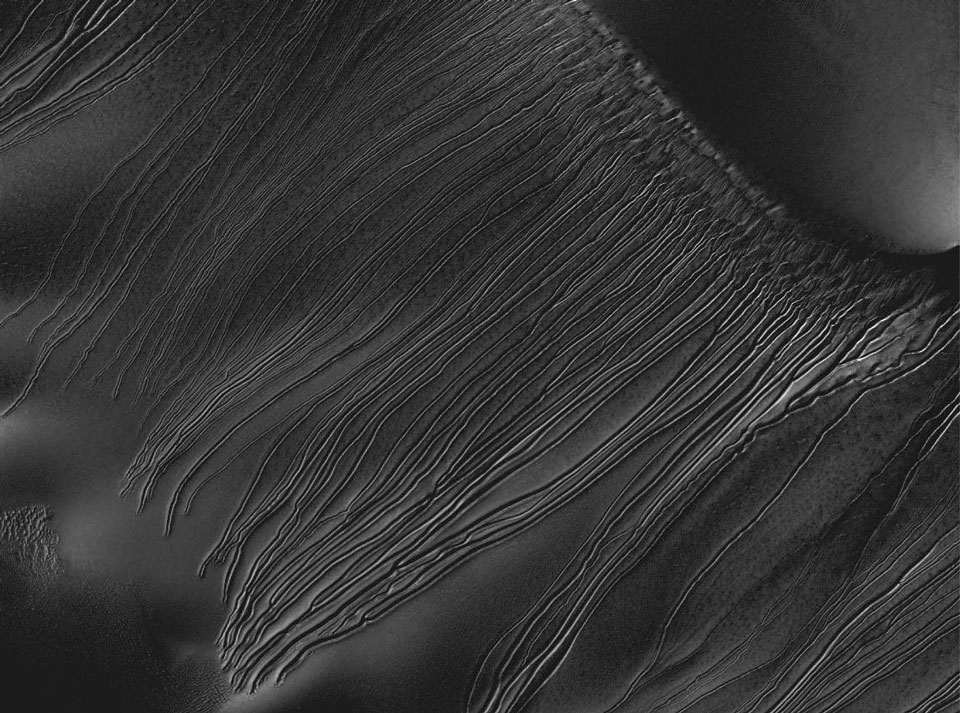
What creates these long and nearly straight grooves on Mars? Dubbed linear gullies, they appear on the sides of some sandy slopes during Martian spring, have nearly constant width, extend for as long as two kilometers, and have raised banks along their sides. Unlike most water flows, they do not appear to have areas of dried debris at the downhill end. A leading hypothesis -- actually being tested here on Earth -- is that these linear gullies are caused by chunks of carbon dioxide ice (dry ice) breaking off and sliding down hills while sublimating into gas, eventually completely evaporating into thin air. If true, these natural dry-ice sleds may well provide future adventurers a smooth ride on cushions of escaping carbon dioxide. The above recently-released image was taken in 2006 by the HiRISE camera on board the NASA's Mars Reconnaissance Orbiter currently orbiting Mars. Astrophysicists: Browse 600+ codes in the Astrophysics Source Code Library